Good book recommendation
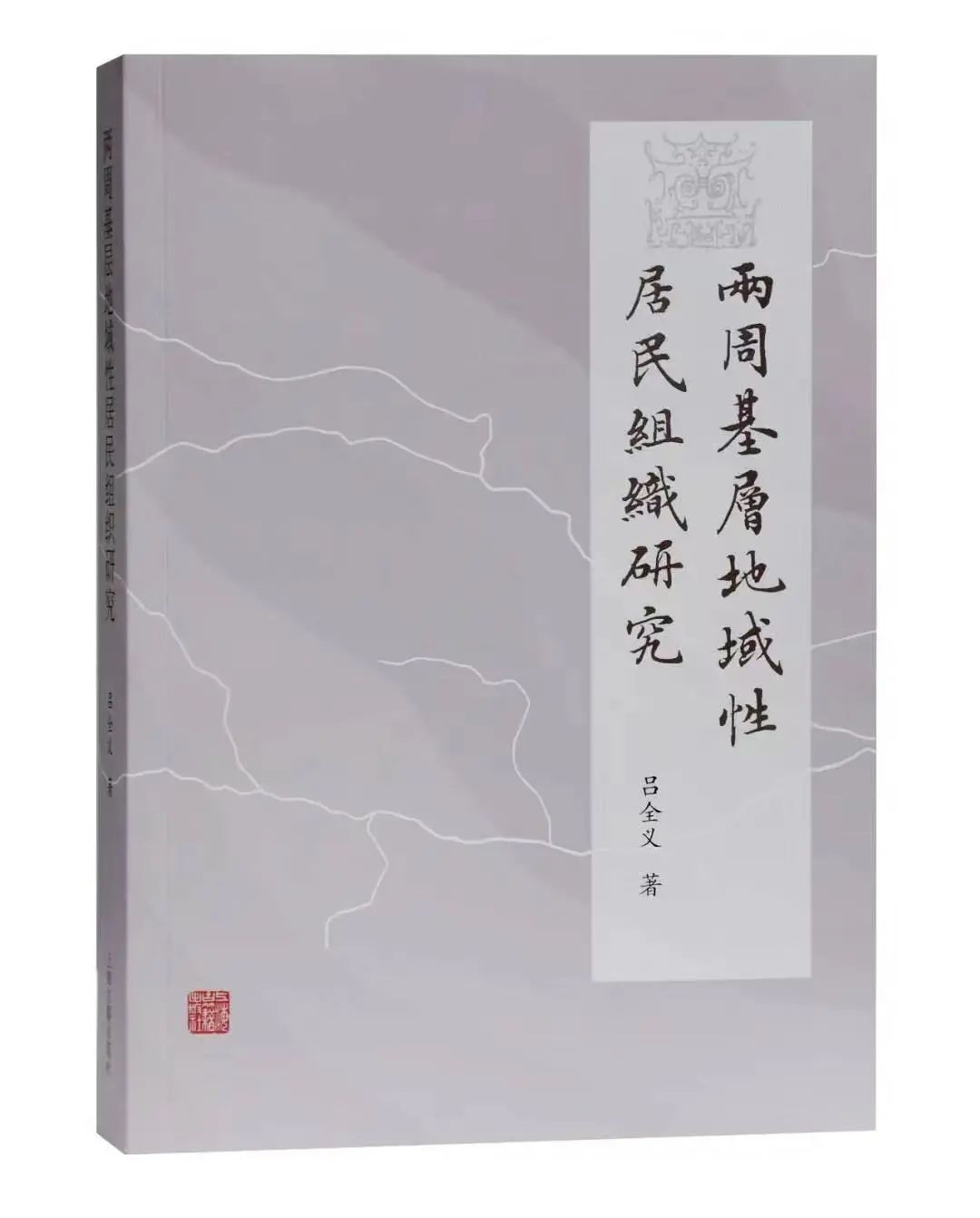
Two-week research on regional residents’ organizations at the grass-roots level
By Lu Quanyi
Shanghai Ancient Books Publishing House
one
synopsis
This book takes the two weeks of the pre-Qin period as the scope, takes the grass-roots regional administrative residents’ organizations as the research object, and discusses the track of its emergence, development and evolution. During the Western Zhou Dynasty, the nature and basic form of "Li" in handed down documents and unearthed bronze inscriptions were outlined. During the Spring and Autumn Period, the following three issues were mainly discussed: the basic forms of "Li" and "Xiang", the basic situation of "Zhou" and "Bookstore", and the similarities and differences of "Three Kingdoms and Five Disgraces" recorded in "Qi Yu" and "Guan Zi Xiao Kuang". During the Warring States period, it mainly focused on strengthening the organizational function of residents in Chu, Qi, Qin and Sanjin. There are also the functions played by residents’ organizations during the war reflected in Mozi’s articles on guarding the city. Finally, this paper sorts out the organizations of residents in the country seen in Zhou Li to supplement the records in other documents.
two
Brief introduction of the author
Lv Quanyi was born in Wutai County, Shanxi Province in 1969. After graduating from normal school in 1986, he served as a teacher in primary school, junior high school and senior high school. In 2010, he obtained a master’s degree in ancient history from China, Fujian Normal University, and studied under Professor Ba Xinsheng. In 2016, he obtained a doctorate in ancient history from China, Peking University, and studied under Professor Zhu Fenghan. In 2016, he joined the history department of taiyuan normal University, mainly engaged in the study of pre-Qin history and unearthed documents.
three
catalogue
Xu Yi Zhu Fenghan
Xu erba xinsheng
preface
The first chapter is the emergence and basic form of the local residents’ organizations at the grass-roots level in the Western Zhou Dynasty.
The first section discusses whether there are regional residents’ organizations in the late Shang Dynasty.
The nature of "Li" in the Western Zhou Dynasty
Section III Basic Forms of "Li" in the Western Zhou Dynasty
The fourth quarter "Li" regional settings in the Western Zhou Dynasty
Section V Exploration on the Scale and Structure of "Li" in Western Zhou Dynasty
Section VI Nature of Some Numbers "Yi" in the Western Zhou Dynasty
summarize
The second chapter is the popularization and diversification of grassroots regional residents’ organizations in the Spring and Autumn Period.
The first section is about the time when the resident organization "township" appeared in the pre-Qin period.
The second section of the Spring and Autumn Period of the village regional settings and their relationship.
Section III Official, Function, Scale and Function of Villages in the Spring and Autumn Period
Section IV Diversity of Municipalities in the Spring and Autumn Period
Section 5 Special Resident Organization in the Spring and Autumn Period-"Zhou"
Section VI The Nature and Historical Position of the Book Club in the Spring and Autumn Period
Section VII An Analysis of the Differences of Residents’ Organizations in Qi Yu and Xiao Kuang
summarize
The third chapter is the strengthening of the organizational function of grassroots regional residents during the Warring States Period.
The first section of Chu grass-roots residents organization city, Li, Qiu and above (hence)
The second section discusses the nature of "state" seen in Baoshan bamboo slips
The third section: the control of Chu grass-roots regional residents’ organizations on residents’ social life
summarize
Chapter IV Strengthening the Organizational Function of Grassroots Regional Residents during the Warring States Period (Part Two)
The first section Qi Taowen saw the grassroots regional residents’ organizations
In the second quarter, Qin’s village grass-roots system
Section III Grassroots Regional Residents’ Organizations in Sanjin and Their Officials
summarize
Chapter V Strengthening the Organizational Function of Grassroots Regional Residents during the Warring States Period (Part II)
The first section of the Warring States period, the martial system
Section 2 Household Registration System during the Warring States Period
In the third section, the military function of grass-roots regional residents’ organizations as seen in Mozi’s guarding the city.
summarize
The sixth chapter "Zhou Li" reflects and precipitates the two-week grassroots regional residents’ organizations.
The first section "Zhou Li" features and times of grassroots regional residents’ organizations.
Section 2: The system of residents’ organizations and its social functions as seen in Zhou Li.
The third section "Zhou Li" of the Wu system and household registration system
The fourth section "Zhou Li" in the grass-roots regional residents organization officials selection and performance appraisal system.
summarize
tag
references
Appendix 1: Abbreviations of ancient writing materials cited in this book.
Appendix II: Xiang He Li in Qin Dynasty’s written materials
postscript
Swipe up and down to browse
wanton
Preface 1 (Zhu Fenghan)
This book by Dr. Lu Quanyi was completed on the basis of his doctoral dissertation after several years of supplement and revision. This book makes a systematic study on the development and change of grass-roots regional residents’ organizations from the Western Zhou Dynasty to the Warring States Period, and its achievements are helpful to deepen the understanding of the evolution of state structure in the past two weeks.
The evolution of the so-called two-week state structure is actually a transition from the feudal form of the Western Zhou Dynasty, which is still an early state in China, to the long-lasting county system form in later generations. This evolution is a kind of social transformation in the history of China, and its research value is self-evident.
Among the elements of national structure, social groups and communities are two very important ones. During the two-week period, the grass-roots regional residents’ organizations are closely related to the above two elements. From the breeding and development of regional residents’ organizations and their interaction with the state and government, we can see the reflection of the evolution of social structure in grass-roots society, as well as the process of continuous adjustment of the administrative division management system of the state and government with the development of regional residents’ organizations, and how regional residents’ organizations in various countries gradually became the social basis for the implementation of centralized politics after the Spring and Autumn Period.
Scholars have done research on this topic in the past, but because the research materials are not sufficient, and the materials related to grassroots society are relatively scarce and scattered, just like other historical issues in the pre-Qin period, so the previous research is macro and the lines are rough as a whole. Moreover, even in the face of limited data, researchers have many differences in understanding and have different views on some specific issues. Therefore, it is still necessary to make a more in-depth textual research and analysis of all kinds of materials that have been used in the past on the basis of various studies, and draw a more appropriate view, and it is certainly better if we can hook up useful information from materials that everyone turns a blind eye to. In addition, many newly unearthed documents in recent years are beneficial to this study, which can enrich our understanding of many problems discussed in the past and even make up for some blank points in research. In view of the above situation, this research done by Quanyi still has high academic significance.
Specifically, I think the work done by this book in the following aspects should be affirmed:
Firstly, it outlines the development stages and characteristics of grass-roots regional residents’ organizations from the Western Zhou Dynasty to the Warring States Period. It can be said that the Western Zhou Dynasty was the stage of the emergence and initial formation of grassroots regional residents’ organizations, the Spring and Autumn Period was the stage of its popularization and diversified development, and the Warring States Period was the stage of strengthening the functions of regional residents’ organizations. The clue is clear, which roughly grasps the staged development characteristics of grassroots regional residents’ organizations.
In the Western Zhou Dynasty, there was no unified understanding on whether Li was a grass-roots regional residents’ organization, and some scholars still denied it. This book makes a detailed analysis and demonstration of the inscriptions on bronze and handed down documents of the Western Zhou Dynasty, and discusses the reasons, forms, setting methods and scale of the local residents’ organizations at the grass-roots level at that time, which exceeds the predecessors in the depth of research.
During the Spring and Autumn Period, this book mainly grasped the characteristics of the systematization of grassroots regional residents’ organizations, proved that "township" appeared in the Spring and Autumn Period, and emphatically investigated the formation of the system of "township" governing "Li" and the administrative function of the system. At the same time, it discussed various grassroots regional residents’ organizations that appeared in various countries at that time, such as "Zhou" in Jin and Chu and "Bookstore" in Qi, which were more independent.
For the Warring States period, due to the imbalance of the existing data in different countries, the research can only focus on a few countries. However, in view of the general balance of the development level of social structure at that time, the materials of these countries should still roughly reflect the situation of regional residents’ organizations at the grassroots level at that time. In addition to a few handed down documents, the materials used depend to a great extent on bamboo slips, Wen Tao, seals and seals, etc. On the basis of previous studies, the author made a more detailed textual research on these materials. Among them, the nature, scale and hierarchical relationship of grass-roots regional residents’ organizations such as Zhou, Li, Yi, Qiu in Baoshan bamboo slips and Sui in Geling bamboo slips are mostly revised. In addition, it is also profound to analyze the connotation of Qi Wen Tao, explore the source of pottery craftsmen in Qi State, and investigate the implementation of the system of martial arts in villages of other countries.
How to deal with the book "Zhou Li" in the study is a problem that all scholars who study pre-Qin history will encounter. Although the canon system described in it may not be a record of a specific historical period, it should be based on some books, especially as a reference for the study of the history of the Eastern Zhou Dynasty. This book puts the analysis of the data of Zhou Li at the end of the book, which is also a kind of processing method, that is, the system and social functions of the grassroots regional residents’ organizations mentioned in Zhou Li are used as a reference and supplement to the situation of the grassroots regional residents’ organizations in the previous two weeks.
This book is still in its original state, that is, the writing of doctoral thesis, which I discussed with Quan Yi. This topic is not easy to do, and it is very laborious to do. However, since this topic can still be done in detail and in depth, it is worthwhile if this work can play some roles in deepening the research on this extremely meaningful topic in pre-Qin historiography. Now that the book is about to go to Fu Zi, I think that the original goal may be roughly achieved. Of course, there will be all kinds of omissions and shortcomings in the book, which requires the author to pay attention to the criticism from the academic circles as a rare opportunity to improve his academic level.
If writing on this topic, on the basis of existing data, is there anything that can be further considered, one of the problems I think of is the need to consider the important factors that promote the development of regional residents’ organizations in the past two weeks from a macro perspective, especially if it can be explained from a theoretical height, it will be more helpful to deepen the understanding of the issues discussed in this book and its historical significance.
December 20, 2019
five
Preface II (Ba Xinsheng)
Dr. Lu Quanyi sent me the manuscript of Fu Zi, begging me to preface it. The author studied for a master’s degree from me in Fujian Normal University, and then he was admitted to the Department of History of Peking University, where he studied for a doctorate from Mr. Zhu Fenghan, a famous pre-Qin history researcher in China. Under the careful guidance of Mr. Zhu, he not only successfully completed his studies, but also made great achievements in learning.
one
Looking at the thick revised manuscript of doctoral thesis sent by the author, I can’t help thinking. It was on the eve of Teacher’s Day in 2007, and all my graduate students came to visit me at home. I don’t know one of the dozen students at all. I can’t help asking, "Whose student are you?" He said, "I am also your student." I was surprised when my classmates laughed. It turned out that he was a new graduate student. I told him that according to the school practice, at the end of the first semester, the tutor and the student should make a two-way choice, and it is not yet time to choose the tutor. He insisted: "I just want to be your student!" " Since then, he has expressed this wish to me many times, and finally decided to take me as his tutor to study the history of pre-Qin at the end of the semester.
The author is the oldest graduate student I have enrolled, but his study drive is no less than that of any young classmate. For example, the author’s allowance for years of work before entering school is slightly higher, but it is only less than 300 yuan. Obviously, it is difficult to maintain normal study and life in Fuzhou by relying on such an allowance. With many years’ teaching experience in high school history, he can find a college entrance examination tutorial class to earn some living expenses, but he is very busy with time and almost devotes himself to his study. For another example, some of my students once told me that the author had never even been to the famous three lanes and seven alleys in Fuzhou during his study. I think this is probably because he is older and has a stronger sense of urgency in reading!
The author was also one of the students who contacted me more after class that year. I remember that "how to lay a solid research foundation" was one of the topics we initially discussed. In order to lay a good foundation, during his master’s degree, he not only completed the required courses offered by our college, but also attended the special course of Sui and Tang Dynasties history for master’s students in our college. In addition, he also attended the phonology, philology, exegetics, philology and edition bibliography for master’s students in the College of Literature. Some of the above courses have accepted my advice, and some of them are very necessary and he took the initiative to take the time to attend. Most of these courses are quite specialized and difficult, and it is difficult to achieve high attainments in a short time. However, in order to broaden his knowledge and lay a solid foundation, he worked hard and worked hard, which shows that. It is on this basis that his master’s degree thesis "A Study on Inscriptions of Chen Chenxi", which is a study of bronze inscriptions that general graduate students avoid now, won wide acclaim from the defense members.
The above impressions left by the author in those years can be summarized as: learning wholeheartedly and facing difficulties. Perhaps it is because of his persistence in learning that he chose Peking University for further study after graduating from Fujian Normal University.
two
Based on the doctoral dissertation, the author’s revised manuscript studies the emergence, diversified development and functional strengthening of grass-roots regional residents’ organizations in the two-week period, which not only helps to have a more complete and clear understanding of itself, but also helps to understand the formation, development and evolution of the country in the pre-Qin period, and also helps to understand the motivation and conditions for the transformation from enfeoffment system to county system. It is also an unavoidable and important topic for us to grasp the structural form of the pre-Qin country, so the importance of its topic selection is self-evident. This issue has long been concerned by researchers. Due to the limitation of research conditions, although there are many achievements in previous research results, there are few monographs on the breakthrough research of grassroots regional residents’ organizations in two weeks as a whole.
Looking at the research results of the author’s book, I was deeply impressed by two aspects:
First, when investigating the "two-week grassroots regional residents’ organization", the first difficulty encountered should be the issue of historical materials, which is precisely because of the relative fragmentation, poverty and lack of historical materials, which has affected the emergence of the breakthrough research results. Fortunately, the excavation of considerable archaeological data in recent years has changed this problem. The author made extensive use of unearthed ancient writing materials: from inscriptions on Oracle bones to two-week inscriptions, bamboo slips and silks of the Warring States Period, Qin and Han Dynasties, seals and seals, etc., and comprehensively collected, sorted out, hidden and hooked the historical materials involved in the topic, and the hard efforts made were imaginable. Zhou Li, as a literature material for the study of pre-Qin history, is desirable, but it needs to be carefully used. The author carefully used the historical data of the regional residents’ organization in Zhou Dynasty reflected in the literature of Zhou Li, especially made an investigation of the times by referring to the relevant materials and archaeological materials, that is, studied with the "double evidence law", which greatly enriched our understanding of the regional residents’ organizations at the grassroots level in two weeks, which should be fully affirmed.
Secondly, the academic circles hold different views on when the regional residents’ organizations appeared in the pre-Qin period. The author, taking Yihou Luogui in the early Western Zhou Dynasty as a breakthrough, collected all rubbings and photos of the inscription, compared it with the reliable "Sheng" glyph in the early and middle Western Zhou Dynasty, and agreed that the word "Li" after "Yi (Ci) Cai (Yi Wang Ren) Qi" was convincing. Textual research not only laid a solid foundation for this book, but also provided a strong support for most scholars to claim that the "Li" in the Western Zhou Dynasty belongs to residents’ social organizations. On this basis, the author investigates the naming, official position and other basic forms (layout, clan, evolution, scale and structure) of "Li" in the Western Zhou Dynasty, and especially puts forward that there are some digital "cities" under "Li" in the late Western Zhou Dynasty.
The author’s investigation of grass-roots regional residents’ organizations in the Spring and Autumn Period focuses on the characteristics of popularization and diversification. This paper mainly demonstrates the regional setting, relationship and social function of township and village in the Spring and Autumn Period. In addition, the author also investigates the hierarchy and diversity of the "city" in the Spring and Autumn Period and its development and evolution in the Spring and Autumn Period, and investigates the particularity of the "state" of the grassroots regional residents’ organizations in the Spring and Autumn Period; The investigation of the nature and evolution of the "book club" in the Spring and Autumn Period is also innovative.
The author further classifies and reinterprets the resident organizations involved in the bamboo slips of Baoshan in the Warring States period on the basis of scholars’ existing research, and advocates that there is a "Li" under the state of Chu by using unearthed materials; It is also argued that not all the states of Chu are located near the capital and other capitals, and the social life organized by Chu residents is also discussed in depth. The grass-roots regional residents’ organizations in countries other than Chu and the social life of the residents in them are also sorted out by using unearthed materials as much as possible, and there are many new opinions. In particular, using Qin bamboo slips such as Qi Wen Tao, Yunmeng Shuihudi and Liye to investigate the basic situation of "Li" and "Township" of Qi and Qin, further enriched and refined the academic understanding of grassroots regional residents’ organizations in the Warring States period.
The author uses the "double evidence law" to study the two-week grass-roots regional residents’ organizations with broad vision, clear structure and informative materials. The writing of this book is logical, and it can put forward original opinions and make reasonable arguments. The argument of the problem has been "well-founded and justified", seeking truth from facts and judging cautiously. What is commendable is that the author has not only made many achievements in micro-research, but also accurately summarized the stage characteristics of grassroots regional residents’ organizations in different stages in the two-week period, namely, the emergence of grassroots regional residents’ organizations in the Western Zhou Dynasty, the popularization and diversified development of grassroots regional residents’ organizations in the Spring and Autumn Period, and the strengthening of the functions of grassroots regional residents’ organizations in the Warring States Period, and also showed the internal relations of the three different development stages, which gave people enlightenment.
In a word, the topic selection of the author’s manuscript "Research on Regional Residents’ Organizations at the Grassroots Level for Two Weeks" is very important, and the author’s hard work and achievements around this topic are obvious to all.
However, the "two-week study of regional residents’ organizations at the grass-roots level" is an important topic, involving many issues. For example, Engels clearly put forward two important signs of the emergence of the state in "Family Private Ownership and the Origin of the State": "Where the state is different from the old clan organization, the first point is that it divides its citizens by region" and "The second difference is the establishment of public power". Here, "dividing its citizens by region" is the regional residents’ organization discussed in this book. Obviously, Engels regarded it as one of the necessary conditions for the formation of a country. Then, why did China emerge as a country and enter a civilized society before the emergence of regional residents’ organizations? In other words, what is the difference between the formation of China countries and the formation of Greek and Roman countries? Scholars have paid great attention to the study of the self-development path formed by China countries. The in-depth discussion of this issue will surely deepen the study of China’s history and culture. Put forward this question for the author and readers to encourage.
After the publication of this book, it will certainly attract the attention of the academic circles. I sincerely hope that the author can listen to the opinions of all parties with an open mind, modify it and achieve perfection. And wish the author greater achievements in future research!
Peony Garden in Fuzhou, Fujian in January, 2020.
Data: Shanghai Ancient Books Publishing House.
Editor: Xu Nuo
Shangguan author: Shuxiang Shanghai