Viewing the Tianhe River on July 7th: the romantic star party in the first autumn.
In July of the lunar calendar, summer turns to autumn.
Shuowen explains "seven, the righteousness of yang"; In the hexagrams of the Book of Changes, the number "seven" means "repeat" and "return": "repeat the Tao and return in seven days." Xu Zheng’s "Three-Five Calendar" in the Han Dynasty stated: "The number starts from one, stands at three, becomes five, is seven, and is nine." It is recorded in History of Han Dynasty: "Seven things are the beginning of man in the four seasons of heaven and earth". In the concept of time of the early people, the double "seven" overlapped, which was given a mysterious and special meaning.
There are many nicknames for "July 7th" festivals, such as "First Autumn, Week, Fairy Festival, Qi Festival, Luo Zhi Festival, Qiaori Festival, Qiaoqiao Festival" and so on. The name of "the first autumn is a beautiful evening" originated from the first solar term in autumn-beginning of autumn Duoban, and the autumn harvest is about to start after beginning of autumn. Xie Lingyun’s Poem of Chanting for Cows and Girls on Tanabata describes: "The fire died in the first autumn festival, and the new bright string and the moon and the evening. The moon string illuminates the household, and the autumn wind enters the gap. " As the saying goes, "On July 7th, pinch the grain to eat" and "On July 7th, bask in Gu Mi", at this festival, farmers should not only be grateful for the first harvest in the first autumn, but also make prayers for the bumper harvest in the big autumn, which is extremely sincere.
"July 7th" is closely related to the theme of silk, silk and textile, so it is called "Luo Zhi Festival" and "Qi Festival", which is related to the star god of the main textile-Weaver Girl. In the Southern Dynasties, Liang Wudi’s "Qixi" poem says: "A wonderful meeting is not a wonderful festival, but a good year." Xia Wanchun, a Ming Dynasty poet, also mentioned in the fifth poem "Autumn": "Ritual is not an auspicious festival, but a wonderful meeting is a cool evening." The Qing Dynasty’s "Yuan Jian lei Han, at the age of seven July" stated: "Qi Festival is also the festival of Luo Zhi in the evening." In addition, the "Begging for Clever Skills Festival and Needle-piercing Festival" are named after the Chinese Valentine’s Day custom, which shows the colorful folk activities of this ancient festival.
First, the worship of stars and the legend of Niu Nv
"July 7th, watching the Milky Way". The ancients who pursued order "looked up at astronomy and looked down at geography", and planned the stars in the sky in an orderly way, which was called "dividing the stars" and "dividing the fields". Zhang Heng, an astronomer in the Eastern Han Dynasty, said in Lingxian: "Stars are born in the earth, refined in the sky, and ranked in the wrong place, each with its own genus. ….. In the wild, like things, like officials in the DPRK, like things in people, so prepare. " This simple view of nature and cosmology holds that there is a "correspondence between heaven and man" between the eternal starry sky and the world. Our ancestors accumulated abundant astrological knowledge. As early as the Warring States Period, the complete names of the 28 stars appeared. There is a star map on the surface of the lacquer box cover excavated from the tomb of Zeng Houyi in Hubei Province, showing the stars in the sky. Beidou is a symbol of the northern sky, while Twenty-eight Nights are circulating in the southern sky.
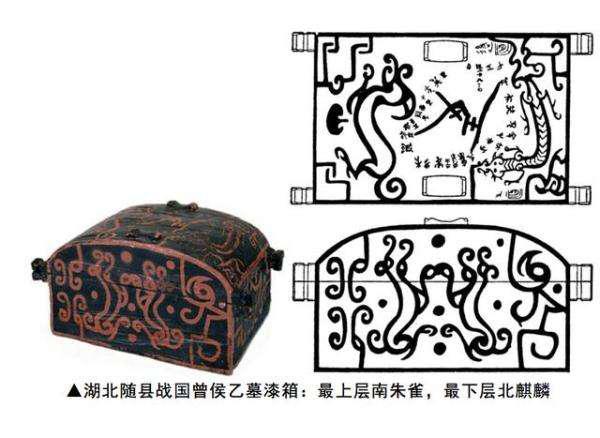
The ancients measured the seasons by observing the positions of the stars. "Da Dai Li Xia Xiaozheng" notes: "Han case households. Han is also a river. The case is also the case, and the direct household is also right. " It means that the Milky Way rotates in the night sky, and in July, the Milky Way just stands vertically north and south. The window door faces south, and the Milky Way just stands upright in the doors and windows. "Poetry, Elegance, Yunhan" says: "Mourning for the Yunhan, Zhao returns to the sky." It also points out the celestial law of the wide and bright galaxy "running" in the night sky.
"To the west of Tianhe, there are bright stars", called "Cowherd Star"; "East of the Tianhe River, there are stars slightly", which is called "Vega". The bright binary stars are separated on both sides of the Milky Way. There are six Altair stars in the southeast of Altair, which are like the outline of a horn; In the southeast of Vega, there are four fading stars, which form a quadrilateral like a loom, so they are aptly named after the binary stars with the most simple image in the world. The Cowherd and the Weaver Girl perform their respective duties. The Historical Records of Justice says, "The Altair is unknown, and the cows in the world will die of plague." It is also stated: "Weaver Samsung is mainly engaged in fruits, silks and treasures." "(Samsung) is dark and micro, and the female workers in the world are abolished; Clear, rational. The big star is angry and angular, and the cloth is expensive; If you don’t see it, you will start. " It can be seen that it plays a vital role in farming society.
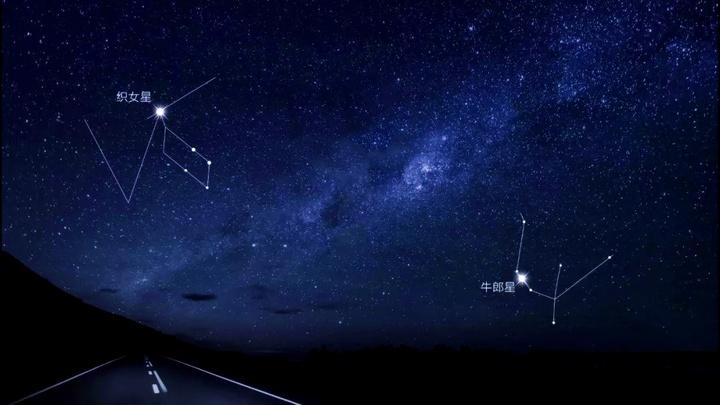
Altair and Vega
Although the binary stars look at the river every other day, the wise ancients observed that in the first autumn of July in the lunar calendar, the distance between the two stars is the closest. "If you fall, you will be a weaver girl, and you will be seven times a day." Xiaoya Dadong accurately describes the change of Vega seven times a day; "Xia Xiaozheng" also says that "in early July, the weaver girl is heading east". Pushing the window in the night sky, looking up at Yinhan, the visual intuition provides an endless source of inspiration for the generation of the fairy tale "Cowherd and Weaver Girl, Tianhe Phase".
The myth of "Cowherd and Weaver Girl" was formed about the pre-Qin period, and its lower limit will not be later than the late Warring States period. In the chapter "Take a Wife" of the Japanese Book unearthed in Yunmeng Sleeping Tiger Land, there has been a description of the marriage of the cowherd and the weaver girl. During the Han Dynasty, the "Legend of Cowgirl" was about to take shape. "History of Emperor Wu of Han Dynasty" once recorded that there are two statues of Petunia and Weaver Girl in Kunming Pool, "There are two stone men in Kunming Pool. Set up a morning glory and a weaver girl in the pool to look like the Tianhe River. " Ban Gu’s "Xidu Fu" and Zhang Heng’s "Xijing Fu" all describe this. The cowherd and the weaver girl in the Han Dynasty stone reliefs are mostly presented as ordinary farmers and peasant women, which is a reflection of the natural economic model of "men plowing and women weaving" in the agricultural society at that time. The portrait of the top of the sarcophagus excavated in Xinsheng, Pixian County, Sichuan Province, is engraved with the portraits of "Dragon and Tiger" and "Cowherd and Weaver Girl". Cowherd holding a cow, struggling to move forward, while Weaver girl holding a shuttle, is anxiously waiting for the arrival of Cowherd.
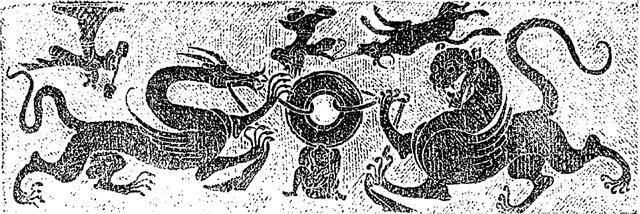
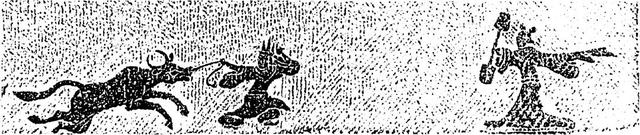
In 1973, the sarcophagus cover was unearthed in Xinsheng Township, Pixian County, Sichuan Province. The picture above shows Qinglong and Baihu holding the jade, and the picture below shows the cowherd and weaver girl.
"All the way Altair, JiaoJiaoHe han female. Fine hands, make a loom. All day long, there is no chapter, and tears are like rain. The river is clear and shallow, how much difference does it make? Ying Ying Yi Shui, the pulse is speechless. " This poem Nineteen Ancient Poems by Han Yuefu puts the suffering of the lovesickness of cows and girls in a long farewell period, which indicates that the story plot of the cowherd and the weaver girl has tended to be complete and stereotyped. The story of the Cowherd and the Weaver Girl, which entered the gradual period, was added with more social factors that caused the separation between the cow and the girl and the week, and its symbolic significance was more prominent. For example, in the Southern Dynasties, Liang Yinyun wrote in his Novel: "To the east of the Tianhe River, there is a weaver girl, and the son of the Emperor of Heaven is also there. Every year, the loom labors, weaving into a brocade dress, and the appearance is too messy. The emperor pitied him for being alone, promised to marry a cowherd in Hexi, and then abandoned weaving after marriage. The Emperor of Heaven was angry and ordered to return to Hedong, but they met once a year. " The patriarchal system represented by the Emperor of Heaven and the moral discipline of persuading farmers and weaving are obvious.
The legend of the Cowherd and the Weaver Girl is the result of our ancestors’ personification of natural stars and their naive and magical romantic imagination. Since then, it has experienced a double evolution from deification to secularization, and penetrated into the cultural psychology and way of thinking of the Chinese nation through various channels such as literature, art, customs, religion and morality.
Second, Weaver Girl’s Poetry and Painting and Begging for Cleverness
In the night sky at the turn of summer and autumn in July, Vega rose to the highest point of the year, dazzling. At this time, the weather turned cold, and women were busy spinning and weaving to prepare winter clothes. In the silent night, the weaver who works by the loom can look up and see the bright Vega who is the main weaver, silently making infinite expectations for a happy life.
The identity of the weaver girl is "the grandson of heaven", "the daughter of the emperor of heaven" and "the goddess of weaving" "The History of the Later Han Dynasty and Tian Wenzhi" notes: "Weaver girl, the son of heaven is a true girl." "Historical Records Tianguanshu" says: "Weaver girl, heavenly daughter Sun Ye." "Samsung, at the eastern end of Tianji, is also a goddess." In the Spring and Autumn Period and the Yuan Dynasty, it is also stated: "The weaver girl speaks, the goddess also, and the ready-made clothes stand for discipline, so Qi can become a literary embroidery, which should be heaven." It is recorded in the Book of the New Tang Dynasty, Official Records: "The Weaving and Dyeing Department made a sacrifice on July 7th". The description of Weaver Girl’s appearance in Song Dynasty’s Taiping Guangji is "bright and gorgeous, dazzling, dressed in mysterious clothes, dragging frost."
With the widespread spread of the love story of the Cowherd and the Weaver Girl, the praise of this Weaver Girl God, who is quiet in appearance, diligent in weaving and faithful in emotion, can be seen from the works of art created by painters and poets in past dynasties. The Zhang Ling, a painter of the Ming Dynasty, painted the Weaver Girl in the Shanghai Museum. In the picture, the Weaver Girl has a plump figure, a bun scarf on her head, a long silk on her shoulders, and a loom in her hand. She looks up and her eyes are far-sighted, and she seems eager to meet her relatives. Towels and silks are flowing with the wind, and the feet gradually blur into clouds and smoke, leaving no background, just like a weaver girl floating in the boundless sky. "The spirit paints a figure, and the crown is mysterious, and all kinds of things are halal, and there is no air of inferiority." As the commentary said, Zhang Ling painted a goddess who is not greedy for the heavenly palace, but yearns for the earthly life infinitely, and her meaning is also continuous, and her feelings are also eager, and there is no air of inferiority.
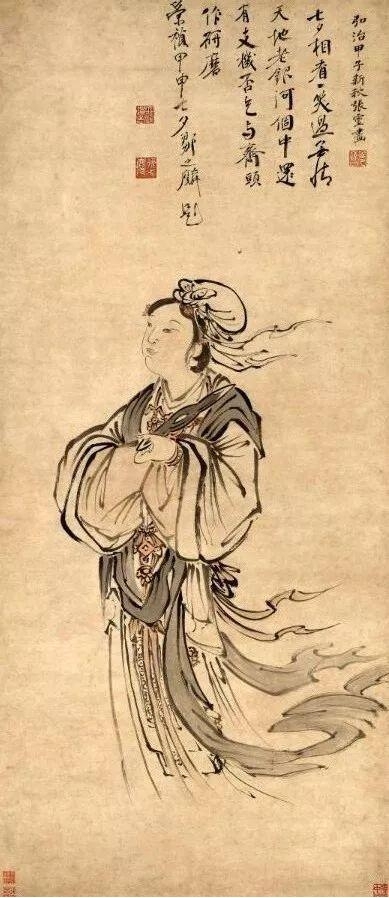
Ming Zhang Ling’s "The Weaver Girl" was collected in Shanghai Museum.
Vega has a variety of clergy, in charge of textiles, melons and fruits, treasures, fertility, child care, marriage and so on. Therefore, people pay homage to her on Tanabata, not only begging for "cleverness" and "wisdom", but also begging for wealth, longevity and children. Ge Hong’s Miscellaneous Notes on Xijing in the Eastern Jin Dynasty states that "women in the Han Dynasty often put a seven-hole needle on the Kaijin Building on July 7th, and everyone is Xi Zhi", which is the earliest document about begging for cleverness. Zhou Chu’s "Records of Local Customs" says: "On July 7th, I swept the court at night, gave several banquets, set up preserved wine, scattered fragrant powder, and begged for wealth and longevity in Hegu Weaver Maid. I had no children, so I could only beg for one, but I could not ask for both. Three years was a good thing to say, and I was quite affected by it." In the Southern Dynasties, Liang Zonggu’s Chronicle of the Age of Jingchu also recorded: "July 7th is the night of the gathering of Petunias and Weavers. It’s evening, and other women tie colorful ribbons, wear seven-hole needles, or use gold and silver stones as needles, and old fruits are in court to beg for cleverness. "
"Seeking a clever picture on Qixi Festival" is an important theme of China’s seasonal painting. The earliest existing "Qiqiao Map" was drawn in the Five Dynasties, and developed to the Ming and Qing Dynasties. It has formed a painting mother with high-rise palaces, needles, melons and fruits, and weaver girls. The Qing Dynasty’s "Tanabata Map", which is collected in the Palace Museum, vividly reproduces the scene of Qixi’s begging for cleverness through skillful reeling techniques. The picture is divided into two parts: the sky and the earth. The sky above is vast and quiet. The cowherd rides on the sacred cow, and the Weaver Girl’s long skirt floats. The two ride on Xiangyun, echoing each other from a distance. The picture below shows the liveliness and vitality of the world: in the courtyard hidden by Lvmu, two women are collecting clothes exposed to the sun during the day in a high pavilion; On the right side of the full moon door, a woman carries a basin, as if preparing to throw a needle into the water; There are several cases in the middle of the courtyard, with offerings such as clever fruit on them, and women standing beside them; In the small pavilion on the left, two women raised their arms and raised their heads to pierce the needle on the moon, gazing at each other in silence and showing piety.
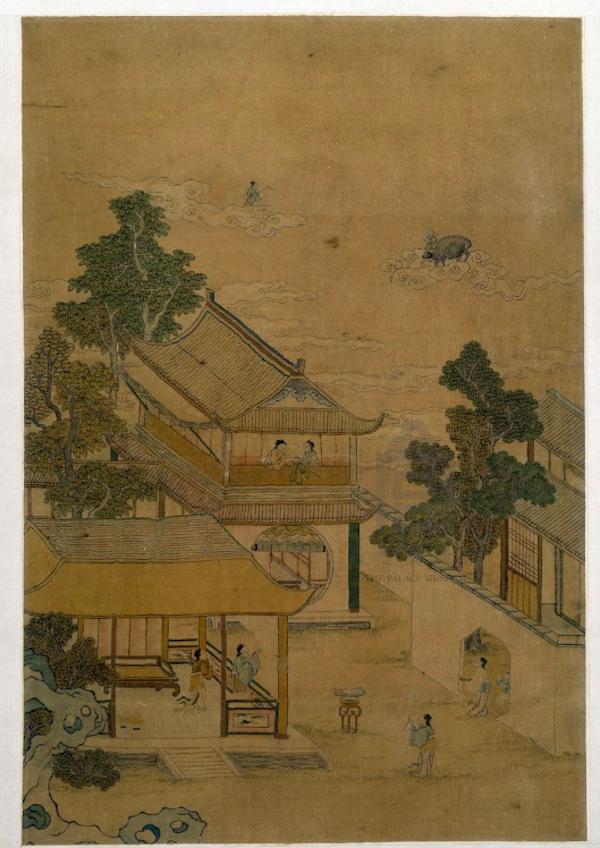
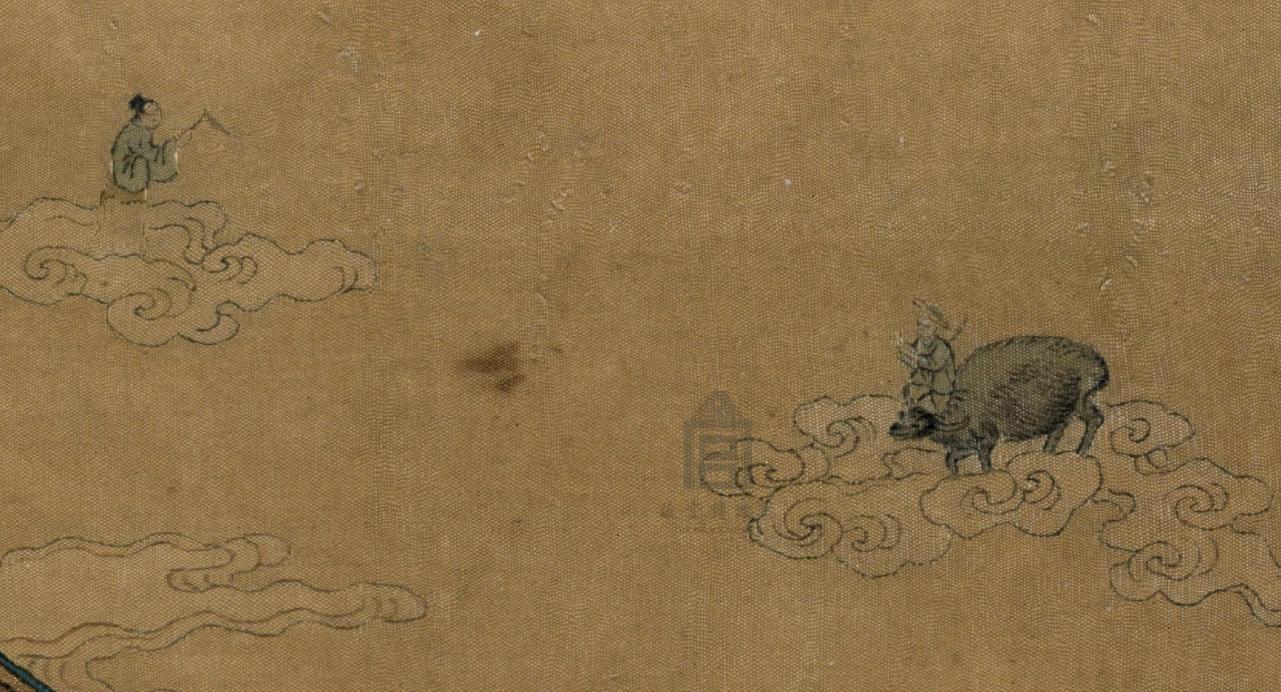
The Palace Museum collects the Qing Dynasty silk "Qixi Map"
In the Qing Dynasty, Yao Wenhan’s "Qixi Map" truly shows the grand Qixi activities of the court from three lines: first, the cowherd and the weaver girl meet at the Queqiao Bridge, aiming at cultivating farmers and persuading mulberry, and then through the depiction of the court sacrificial ceremony, it means that the grain is abundant; In the middle of the picture, there is a begging activity. On the steps, there are ladies who serve spider boxes and water bowls. On the platform, there are women who worship needles. On the left side of Qiaolou, there are ladies who raise their hands to the Weaver, and the characters are lifelike. At the front of the lower part of the picture is the lotus pond in full bloom. There are "grinding and drinking music" on the platform and in the courtyard, and the children who are educated in "six arts" are scattered, suggesting the custom of seeking children and raising children on Tanabata.
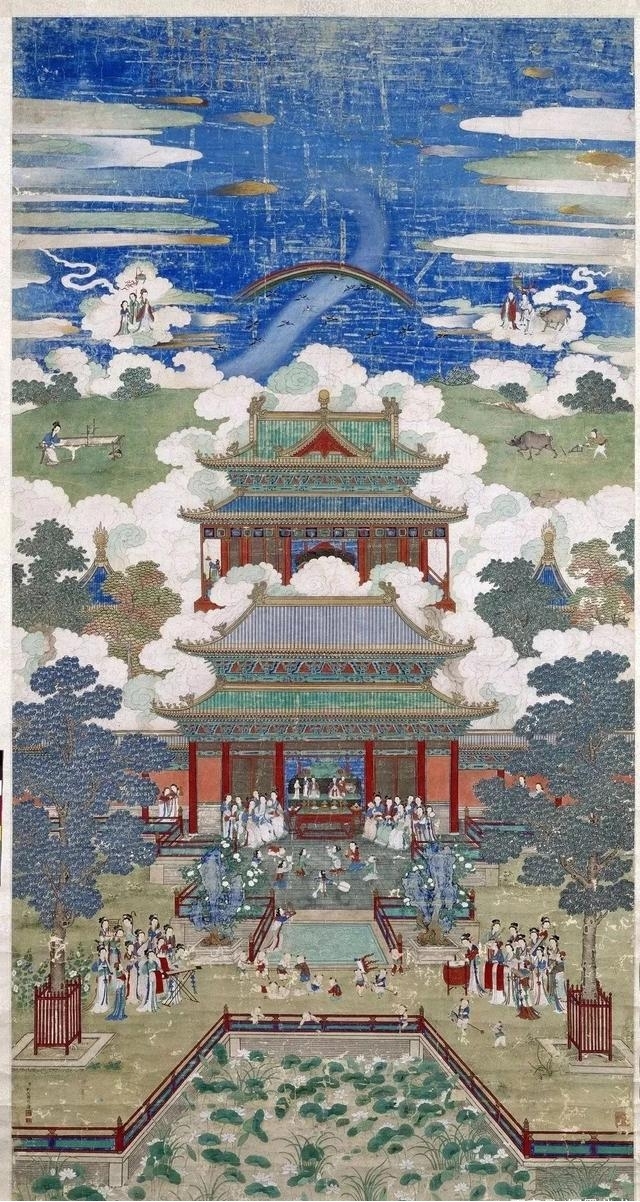
The Palace Museum houses Yao Wenhan’s Tanabata Axis in Qing Dynasty.
In addition to seeking clever pictures, there are also Qixi poems that describe people’s emotional expressions in detail. Qixi poetry, which originated from the Book of Songs, began in Yuefu, flourished in the Six Dynasties and extended to later generations. "Preface to Mao’s Poems" says: "Poets, the feelings of people’s hearts are shaped by words." The Chinese Valentine’s Day poems are full of profound and rich meanings, including the wanderers’ yearning for women, or the relationship between the monarch and the minister, or the confluence with the folk custom of begging for cleverness, or the biography for the cowherd and the weaver girl. For example, Tang Du Mu’s "The night in day order is as cool as water, lying and watching the morning glory and the weaver star"; Wang Jian’s "watching the stars alone by the river, it is difficult to weave Tencel at night"; Cui Ying’s "Chang ‘an City is like a moon in practice, and every family holds a needle and thread this night"; Quan Deyu’s "family members actually like to open makeup mirrors, and wear needles to worship the nine under the moon"; Lin Jie’s "Every family looks at the autumn moon and wears tens of thousands of red silk" and so on.
When the Weaver Girl met Petunia, she did not forget her duty, but left the needle to the Weaver Girl. The feminine beauty in China’s traditional ideas, such as "ingenuity, diligence, kindness, single-mindedness and faithfulness", is embodied in the Weaver Girl, giving off charming light. However, the nationality, aesthetics and moral sense in the legend of Niu Nv and the poems and paintings on Qixi constantly edify people’s sentiments and enlighten their minds.
Third, crossing the bridge, the black magpie and Qiaozhi promote weaving
1. Wuqiedu Bridge
There are several ways for the Cowherd and the Weaver Girl to meet, such as Star Bridge, Swallow Bridge, Phoenix Extradition, Cars, etc., which show the diversity of folklore evolution, and since the Tang Dynasty, it has tended to be unified in the "Queqiao Meeting". Han Ying Shao’s "Custom Pass" stated that "the weaver girl crossed the river on Tanabata, making the magpie a bridge. According to legend, on the seventh day, the magpie’s head was hungry for no reason, because Liang Yidu also crossed the weaver girl." In the Novel of Liang Yinyun in the Southern Dynasties, it is also said: "On the seventh day of autumn, the magpie’s head was high for no reason. According to legend, the Rihe drum and the Weaver Girl would meet in Hedong, and the Wu Magpie would serve as a beam to cross, so all the hair was taken off." In the Tang Dynasty, it was also recorded in the Korean Department’s "Year of Hua Ji Li": "The weaver girl should cross the river on Tanabata and make the magpie a bridge"; In Song Dynasty, Luo Yuan’s "Er Ya Yi" also had "seven days involved in autumn, and the magpies were all in the same category for no reason. According to legend, it is thought that the river drum and the weaver girl will meet in Handong, and the black magpie will serve as a beam to cross, so the hair will be taken off.
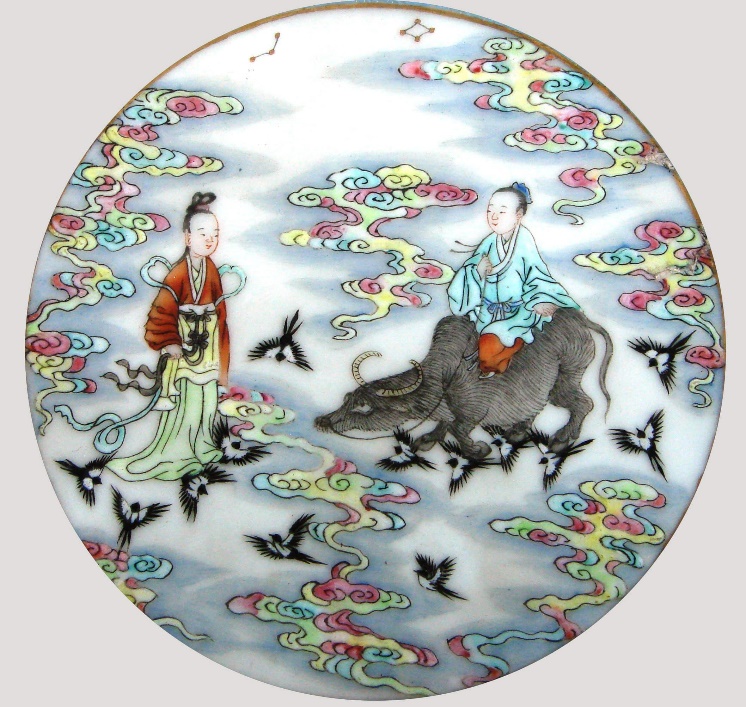
The pastel figures of Jingdezhen official kiln collected in Beijing Art Museum.
There are two reasons why the black magpie can enter the "Legend of Cow and Girl" and become an important medium for meeting. First, the natural attributes of birds, magpies are good at building nests and bridges. Zhang Hua’s "Natural History" in the Western Jin Dynasty says: "The opening of the magpie nest is too old. This is not wisdom, so it is natural." In Duan Chengshi’s "Youyang Miscellaneous Feathers" in the Tang Dynasty, it was stated: "There must be beams in the magpies’ nests … two magpies build nests, and the city holds a piece of wood like a pen tube, which is more than a foot long and is in the nest." It is said that magpies are familiar with the phenomena of yin and yang and are good at bridging. In addition, magpies fly in groups, gather together and have a persistent sense of responsibility. Xu Mian’s "Que Fu" in the Liang Dynasty says: "There are many kinds of wings, and they fly in groups. If it is a cloud, it will be forgotten. " Sui Wei Lian’s "The Garden Tree has a Nest and a Magpie Play to chant it" states: "The fear of jade is always terrible, and the ability to fill the river is already poor … It should arrive in the morning and evening, and it is easy to empty it." Magpies fly like clouds, moving mountains and filling rivers, showing the firm strength and momentum to overcome all difficulties for the "meeting of cows and girls" and playing the role of group heroes.
Secondly, from the cultural image, magpie is a symbol of "good omen, lovesickness and happiness". Tang Dynasty’s "The Legacy of Kaiyuan Tianbao" said: "When people are at home, they all think that the sound of magpies is a good omen, so it is called the good news of Lingque." "Huai Nan Zi Wan Bi Shu" says: "The magpie brain is lovesick." Gao Youzhu: "Take one male and one female magpie brain, burn it in the road, and drink it in the wine every day, which is lovesick." Because magpies are good at building nests, the so-called "allowing family members to be upright and living in a magpie’s nest" has become synonymous with family happiness. In the Book of Songs Zhaonan, it is repeatedly sung: "Wei Que has a nest, Wei Hong lives in it, and his son returns to it, and a hundred taels of it." Taking the magpie nest as a comparison, this paper describes the warm scene of a woman’s wedding reception, and further extends the happy vision of a woman returning to her husband’s room and a happy family.
The short-term meeting between Cowherd and Weaver Girl once a year breaks away from the restrictions of "God and Man" and "Time and Space", which is a testimony and praise to their courage to pursue freedom, loyalty and firm belief in love, and thus becomes a representative symbol of the cultural spirit of Qixi Festival.
Step 2 be clever and promote weaving
Tang Song Zhiwen mentioned two kinds of clever insects in Qixi Poem, one is cricket (promoting weaving), and the other is spider (playing). The poem says, "Stop to borrow crickets, and keep clever spiders."
Crickets are also called "promoting weaving, tending weaving, urging weaving, and laying hens". Cui Bao, a Jin native, said in Notes on Ancient and Modern Times: "Promoting weaving is a speculation, which means that its voice is as urgent as weaving." Notes in "Yi Shu of Poetry": "(Cricket) You call it interesting weaving, and the words made by the supervisor are also". Crickets sing like the sound of weaving on a loom, rising and falling, as if urging the weaver shuttle to weave quickly, thus giving rise to the name "promoting weaving". "In June, the pheasant (cricket) vibrates its feathers, in July, it is in the wild, in August, in September, and in October, the cricket enters my bed." The Book of Songs describes vividly the habits and characteristics of crickets as autumn insects in different seasons. Crickets sing in autumn in July, urging women who undertake the textile mission to work hard on weaving and sewing red, and raise clothes for changing seasons to prepare for the need of winter clothes.
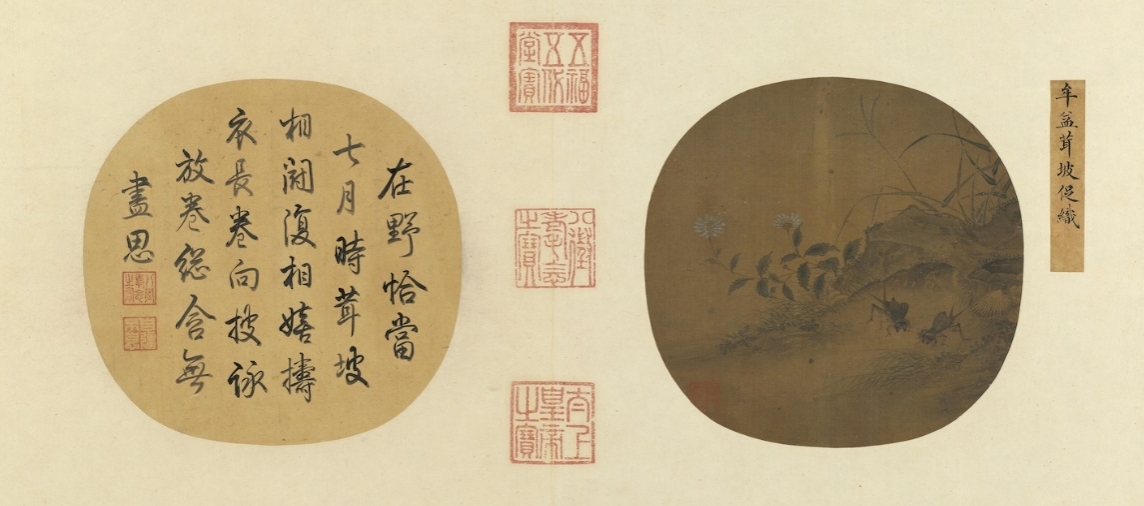
Mu Yi’s Rongpo Promotes Weaving in the Palace Museum in Taipei
Spiders used to be called "clams" and "playful". The sounds of "playful" and "happy" are harmonious, which means auspicious and festive. Han Liu Xin said in Miscellanies of Xijing: "Dry magpies make noise while pedestrians arrive, spiders gather and everything is happy." Tang Quan Deyu also said in "The Theory of Xi Zheng": "I am happy when I am playing." In addition to good omen, spiders are good at weaving webs to catch flying insects, which is also considered as a symbol of cleverness. For example, in Lun Heng, it is said: "Spiders spin webs to catch flying insects, so can people use them safely?" Hong Shi has a poem of "writing a seal on a cold wall in a snail’s writing, and the spider is clever at weaving silk on the eaves", and Su Shi also has a poem of "painting a spider on the eaves to make a web, and a silver magpie to make a bridge".
"The Legacy of Kaiyuan Tianbao" records the details of catching spiders and begging for cleverness in the Tang Palace: "Every night from July 7 to the seventh, when the emperor and the imperial concubine are having a banquet in Huaqing Palace, the ladies-in-waiting Chen Gua Hua Jiu is listed in the court, asking for favor from the cowherd and the weaver girl. They also catch spiders and close them in small boxes until dawn, depending on the sparse cobwebs, thinking that they are clever, and the dense ones speak more skillfully, and the sparse ones speak less skillfully, which is also effective for the people. " Song Mengyuan’s "Dream of China in Tokyo" also recorded that in the capital of the Northern Song Dynasty, in July every year, "on the sixth and seventh nights of the first lunar month, your family made many colorful buildings in the court, which was called the Qiaoqiao Building … Women looked at the moon and put needles in it, or put spiders in it, and looked at it the next day. If the net was round, it was called Qiaoqiao Building." Zong Yi’s Chronicle of Jingchu’s Age also says: "Chen Gua is in the court, and Xi Subnet is on the melon, so he thinks it is appropriate." Using the density of spiders’ webs to predict the skillful weaving skills of young girls in the future, it has also been followed since the Ming and Qing Dynasties.
In the legend of Qixi, the cultural images of animals and insects such as magpies, weaving promoters and spiders are in harmony with the splendid Milky Way, which not only truly reflects the ancestors’ pursuit of "being wise and skillful", but also truly reflects the social characteristics of ancient China, which valued agriculture and weaving.
IV. Conclusion
"Thin clouds are clever, flying stars spread hate", but as long as "the golden wind and the jade dew meet, they will win countless times in the world", which is the best explanation of the true meaning of the legend of love between cows and girls by the poet Qin Guan-in the season of golden autumn wind and glittering and translucent dew, only one meeting is better than countless reunions in the world. The legendary story of the Cowherd and the Weaver Girl embodies the life view, love view and naturalistic world view of China ancestors who pursued perfection. "Guanzi Light and Heavy Armor" said: "If a farmer does not plow, the people may be hungry for it; If a woman does not knit, the people may be cold. " The legend of Cowherd and Weaver Girl, which is born out of the basic mode of agricultural production structure, has been a symbol of Chinese agricultural workers since its birth, reflecting the social forms and consciousness in different historical stages, and is the condensation of Chinese civilized agricultural culture, national consciousness and folk psychology.
On May 20, 2006, Chinese Valentine’s Day, together with five other traditional festivals, was included in the first batch of national intangible cultural heritage list by the State Council. In 2008, "The Legend of the Cowherd and the Weaver Girl" was successfully included in the second batch of national intangible cultural heritage lists; In addition, the Xihe Qiqiao Festival in Gansu Province, the Little Man’s (Children’s) Festival in Shitang, Wenling, Zhejiang Province, the Seventh Sister’s Birthday in Tianhe and other districts in Guangzhou, the Tianhe landscape group in Yunxi, Hubei Province, and the unique Chinese Valentine’s Day customs of ethnic minorities are constantly being explored, protected, restored and reconstructed. The Qixi Festival culture is deeply rooted in the spiritual fertile soil of the Chinese nation, which is brave in exploration and good at creation. It expresses the national cultural identity that attaches importance to nature and harmony, just like the shining stars in the vast vault, which are radiant and immortal.
(Author Fang Yun, Ph.D. in Folklore, lecturer at School of International Education, Shanghai University. )
[Specially published by Shanghai Literature and Art Review Special Fund]