[2023 China Economic Semi-annual Report] Price stability is not deflation, and China’s economic growth is picking up obviously.

  Guangming net news(Reporter Yang Yanan and Zhao Yanyan) With the publication of the semi-annual economic report of China in 2023, China’s economic development trend has once again attracted global attention. The data shows that the consumer price in June was flat year-on-year, from the increase of 0.2% last month to the same year-on-year, and the PPI decreased by 5.4% year-on-year. "Is China’s economy in deflation" has become a hot topic for discussion.

  In response, Fu Linghui, spokesperson of the National Bureau of Statistics and director of the National Economic Statistics Department, responded at the press conference of the State Council Office held on the 17th: "Generally speaking, there is no deflation in China’s economy at present, and there will be no deflation in the next stage. Although the price is currently at a low stage, from the perspective of economic growth and money supply, China’s economy does not meet the conditions of deflation. "

  Steady word, economic operation is picking up.

  Deflation mainly refers to the continuous negative growth of prices and the downward trend of money supply, which is usually accompanied by economic recession. As far as economic growth is concerned, the data show that the GDP increased by 5.5% year-on-year in the first half of the year and 6.3% in the second quarter, which was significantly faster than the economic growth rate of 3% in the whole year of last year, and the economic growth rebounded obviously.

Digital production empowered by science and technology

  On July 10, 2023, a LED photoelectric semiconductor device company in Ruichang, Jiangxi Province, workers rushed to make orders on the intelligent production line. (photo by Wei Dongsheng/bright picture)

  Wang Likun, an associate researcher at the Institute of Market Economy of the State Council Development Research Center, believes that after the economy and society have fully resumed normal operation, domestic production has accelerated its recovery, but the demand is constrained by factors such as income distribution differentiation and unstable income expectations, and the recovery is still lagging behind. "The time difference between supply and demand recovery is the main reason for the low CPI operation this year."

  Fu Linghui said that with the economic recovery, the gradual expansion of market demand and the smooth economic cycle, the relationship between supply and demand will gradually improve, and the high base factor will be gradually eliminated in the same period last year, and the price increase will gradually return to a reasonable level.

  Precision drip irrigation, monetary policy continues to exert its strength.

  At present, China’s macro-economy has recovered steadily, and broad money has maintained rapid growth. At the end of June, the broad money supply (M2), the stock of social financing scale and RMB loans increased by 11.3%, 9.0% and 11.3% respectively, all of which were at a high level, which was obviously different from the typical deflation in history.

  Liu Guoqiang, deputy governor of the People’s Bank of China, said at the press conference of the State Council Office held on the 14th that prices in China were relatively stable against the background of high external economic inflation. Since the beginning of this year, the year-on-year increase of CPI has fluctuated and dropped, and it may go down in July, mainly due to the time lag of demand recovery and the phased phenomenon caused by cardinal utility.

  China has a strong economic resilience, a large market space and a rich policy toolbox. It insists on implementing a prudent monetary policy, scientifically grasps the strength, rhythm and key points of the policy, and does not engage in "flood irrigation". It has a relatively complete control system, rich practical experience and the ability to effectively cope with abnormal market price fluctuations.

  Zou Lan, director of the Monetary Policy Department of the People’s Bank of China, pointed out at the press conference of the State Council Office held on the 14th that in recent years, China has adhered to a prudent and normal monetary policy, with sufficient policy space and rich policy tools to cope with all kinds of new challenges and changes. Subsequently, according to the needs of the economic and price situation, the People’s Bank of China will intensify macro-control, accurately and forcefully implement a prudent monetary policy, and comprehensively use various monetary policy tools such as the deposit reserve ratio, medium-term lending facilities, and open market operations to maintain a reasonable and sufficient liquidity in the banking system, maintain a reasonable growth of money and credit, and promote the steady decline of corporate financing and residents’ credit costs.

  Adequate supply, the overall low price operation.

  Since the beginning of this year, China’s economy and society have fully resumed normal operation, market demand has gradually expanded, production and supply have continued to increase, and economic operation has shown a good trend of recovery. From the perspective of supply fundamentals, China’s prices have a solid foundation for maintaining stable operation.

[Cool Summer Taste] Qingdao International Beer Festival A city's summer carnival

  On July 16, 2023, Golden Beach Beer City, Qingdao, Shandong Province, held a fireworks display at the Oktoberfest. (photo by Yu Fangping/bright picture)

  The data shows that China’s summer grain production has achieved a bumper harvest, and the market supply of vegetables, fruits, meat, poultry, eggs and milk is generally sufficient. In the first half of the year, the output of pork, cattle, sheep and poultry increased by 3.6% year-on-year. Industrial production continued to recover. In the first half of the year, the added value of industrial enterprises above designated size increased by 3.8% year-on-year, 0.8 percentage points faster than that in the first quarter.

  From the perspective of development foundation, China has a complete industrial system, rich human resources, convenient software and hardware infrastructure network, and the safety and security capabilities of grain, energy resources and industrial chain supply chains have been continuously enhanced, and the economic impact resistance and toughness have been significantly improved. Villi, deputy director of the National Economic Comprehensive Department of the National Development and Reform Commission, said at the regular press conference of the National Development and Reform Commission in July, "We are confident, qualified and capable of promoting the continuous improvement of the economic structure, the continuous enhancement of growth momentum and the continuous improvement of development trend, and achieving the goals and tasks of economic and social development throughout the year."

  "Overall, the low CPI increase is the result of multiple factors at home and abroad, which is staged." Fu Linghui said that since the beginning of this year, China’s economy and society have resumed normal operation in an all-round way, market demand has gradually expanded, production and supply have continued to increase, and economic operation has shown a good trend of recovery. From the next stage, with the improvement of China’s economic recovery, the gradual expansion of market demand and the smooth economic cycle, the relationship between supply and demand will gradually improve. "Coupled with the gradual elimination of the high base factor in the same period last year, the price increase will gradually return to a reasonable level."


Reporting illegal acts can be "anonymous" from next year, and malicious complaints and claims will not be accepted.

On January 1st next year, the Interim Measures for Handling Complaints and Reports in Market Supervision and Management newly issued by the State Administration of Market Supervision will be formally implemented. In response to a series of issues that consumers are concerned about, the relevant person in charge of the Network Supervision Department of the General Administration of Market Supervision made an interpretation yesterday (December 10). The reporter noted that the "Measures" allow anonymous reporting and encourage insiders of operators to report according to law; At the same time, once again, complaints about purchasing or using goods or receiving services that are not necessary for daily consumption will not be accepted. This also means that malicious complaints and reports in the name of "counterfeiting" will not be supported.
Allow anonymous reporting and strengthen the protection of informants.
The public may have concerns when reporting illegal acts. The person in charge said that the legitimate rights and interests of informants should be fully protected. Therefore, in encouraging and supporting reporting, the Measures:
One is to allow anonymous reporting. As long as it can provide specific clues about the suspected illegal act and is responsible for the authenticity of the reported content, the whistleblower may not provide his name, address and contact information. If anonymous informants apply for reporting rewards, they should also be handled in accordance with special regulations.
The second is to encourage the insiders of operators to report the acts of operators suspected of violating market supervision laws, regulations and rules according to law.
The third is to strengthen the protection of whistleblowers. It is stipulated that the market supervision department shall keep confidential the information of the whistleblower, and shall not disclose the personal information of the whistleblower and the handling of the report to the whistleblower or any person unrelated to the handling of the report.
Malicious complaints about professional claims will not be accepted.
The "Measures" clarify that six kinds of complaints will not be accepted: they are not the responsibility of the market supervision department, or the agency does not have the handling authority; The court, arbitration institution, market supervision department or other administrative organs, consumer associations or other mediation organizations established according to law have accepted or handled it; Not buying or using goods or receiving services for the needs of daily consumption, or failing to prove that there is a dispute between consumers and the respondent; The complainant knows or should know that his rights and interests have been infringed by the respondent for more than three years; Failing to provide legal complaint materials; Other statutory circumstances.
These provisions are regarded as providing a basis for regulating malicious complaints and claims, and closing the door of complaints of so-called professional claimants for profit. The person in charge of the General Administration of Market Supervision said that such a regulation is to serve the convenience of the people, do "subtraction" as much as possible for cases that are not accepted, implement "negative list management", and curb the abuse of the system.
An industry observation report released by the Internet Law Conference in 2019 pointed out that, unlike professional counterfeiting, "professional claims" are often extorted in the name of counterfeiting. The general path is "one buy, two talk, three report, four review and five lawsuit". At present, "professional claims" are showing the trend of gangs and industrialization, which has affected businesses, platforms, regulatory departments, judicial departments and other parties, destroyed the market business environment, and encroached on the judicial law enforcement resources of consumers’ legitimate rights protection.
Complaints about food and drugs can be mediated by the market supervision department.
"In the field of market supervision, consumers who meet the needs of life can request mediation when they encounter consumer disputes." The person in charge of the General Administration of Market Supervision said that the regulations make it clear that administrative mediation can be applied to all consumer rights disputes in the field of market supervision, including fair competition, food, medicine, consumer goods, special equipment, measurement, certification, testing, price and intellectual property rights.
"In the process of legislation, there was a dispute over whether administrative mediation should be applied to food and drugs," the person in charge said. We believe that the Consumer Protection Law stipulates that complaining to the government is to solve civil disputes, and does not distinguish specific categories of goods and services. Only administrative mediation can achieve this goal. The Food Safety Law not only clarifies the administrative responsibilities of operators, but also stipulates civil responsibilities such as ten times compensation. If we only investigate and deal with illegal acts and ignore civil demands, the civil responsibilities of operators will be frustrated and the tilt protection for consumers will be weakened under the circumstance of high judicial cost.
The person in charge stressed that in addition to food and medicine, many market supervision objects such as automobiles, children’s toys, articles for the elderly, household appliances, furniture, elevators, etc. are directly related to people’s lives and health, and consumers whose personal safety has been violated need multi-channel and diversified rights relief. Therefore, the "Measures" clarify that mediation of disputes over consumers’ rights and interests does not exempt operators from other legal responsibilities that should be borne according to law, and opposes the phenomenon of "substituting punishment with adjustment".
At the same time, considering the particularity and complexity of verification, inspection, testing and appraisal, in order to improve the efficiency of the whole process and avoid consumers’ excessive involvement in energy and repeated work, the Measures stipulate that both parties can’t reach an agreement on the entrusted technical institutions or expenses to terminate mediation and guide consumers to file civil lawsuits.
The national 12315 platform has been launched and can be logged in through WeChat Alipay.
After the promulgation of the Measures, how should the public correctly complain and report? It is understood that in order to standardize the complaint reporting channels and ensure timely and efficient disposal, the Measures stipulate that the public needs to submit complaints and reports through the Internet, telephone, fax, mailing address, window and other channels announced by the market supervision department.
According to the person in charge of the General Administration of Market Supervision, at present, the complaint hotline is unified to 12315, and the national 12315 platform has been put into operation, and supports various convenient login methods such as webpage, APP, WeChat, Alipay and Baidu, which can be associated with the national corporate library, and consumers can submit complaints and reports to any enterprise online anytime and anywhere, and directly receive and feedback online from the local market supervision department. In the first half of 2019, local market supervision departments handled 1.085 million consumer complaints and reports through the platform, which became a new "highway" and "trunk line" for consumers.
Informants can reflect the inaction of the regulatory authorities.
After receiving the complaint, what should the regulatory authorities do if they do not handle it in time? The "Measures" stipulate that complaints shall be handled by the county-level market supervision department of the respondent’s actual business place or domicile, complaints against e-commerce platforms shall be handled by the county-level market supervision department of its domicile, and complaints against operators in the platform shall be handled by the county-level market supervision department of its actual business place or domicile of platform operators, and consumers can choose one according to their own convenience.
At the same time, starting from the needs of improving administrative efficiency, preventing buck passing, reducing idle procedures, etc., the Measures stipulate that if the market supervision department that receives the report does not have jurisdiction, it shall inform the informant to directly submit it to the market supervision department that has jurisdiction. If the market supervision department finds that the case investigated is not under its jurisdiction, it shall transfer the case to the market supervision department with jurisdiction. If the whistleblower thinks that the market supervision department does not act, he can provide relief and supervision through administrative reconsideration, administrative litigation and other procedures.
(The original title is "From next year, reporting violations can be" anonymous "and malicious complaints and claims will not be accepted")
Reporting/feedback

Online transmission of sudden payment of provident fund to increase loan amount official rumor: not feasible

  Recently, a copy of "Housing Provident Fund Raiders 2.0" has been circulated wildly in the circle of friends. Among them, the statement that "sudden payment can increase the loan amount" has caused heated discussion. So, can it really increase the loan amount through this way? China Economic Net reporter learned from the Beijing Housing Provident Fund Management Center that this practice is not feasible. The management center will strictly examine the case of sudden increase in the deposit amount, and once the problem is found, it will be dealt with seriously, and the provident fund loan center also has the right to refuse the loan.

  Online sudden payment of provident fund can increase the loan amount.

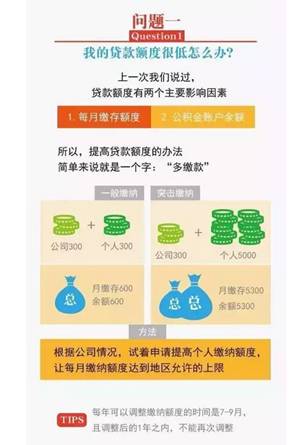
  According to the "Raiders of Housing Provident Fund 2.0" circulating on the Internet, for people with low provident fund loan amount, they can increase the loan amount by paying a sum of money suddenly, because the main factors affecting the loan amount are "monthly deposit amount" and "balance of provident fund account".

  "Raiders" said that according to the company’s situation, try to apply for an increase in the amount of personal contributions, so that the monthly payment amount can reach the upper limit allowed by the region. In addition, the annual payment amount can be adjusted from July to September, and it cannot be adjusted again within one year after adjustment.

  "Raiders" for example, if a person generally pays 300 for the company and 300 for the individual, in this case, the monthly deposit is 600 and the balance is 600. The surprise payment can be 300 for the company and 5,000 for the individual, which becomes a monthly payment of 5,300 and a balance of 5,300.

  Beijing Provident Fund Management Center: If it is not feasible, it will be strictly investigated.

  The Regulations on the Management of Housing Provident Fund stipulates that the monthly contribution of employee housing provident fund is the average monthly salary of the employee in the previous year multiplied by the contribution ratio of employee housing provident fund. The monthly deposit amount of the housing provident fund paid by the unit for the employees is the average monthly salary of the employees in the previous year multiplied by the proportion of the housing provident fund paid by the unit. The deposit ratio shall not be less than 5% of the average monthly salary of employees in the previous year, and cities with conditions may appropriately increase the deposit ratio.

  Generally speaking, the deposit ratio depends on the specific circumstances such as the economic and social development of each region. In 2015, the contribution rate of housing provident fund in Beijing was 12%, and the upper limit of monthly contribution in Beijing in 2015 was 4,654 yuan (including unit contribution and employee contribution).

  Then, can you apply to the company to increase the personal payment amount as mentioned in the "Raiders"? "No, how much the provident fund is paid is based on the salary calculated by the unit, and the deposit ratio in Beijing is 12%. Therefore, the average annual salary is certain, and how much is actually paid, not how much the individual wants to pay. " A person from the Beijing Housing Provident Fund Management Center said, "The provident fund is not taxed, and individuals wish to put it all in the provident fund, but this is obviously impossible."

  According to the expression of the above-mentioned "provident fund raiders", it may mean that some enterprises increase the average monthly salary in disguise to take care of the employees’ provident fund loan amount when they buy a house through illegal operations, so that the amount paid by the provident fund will rise rapidly in the short term.

  In this regard, the above-mentioned person said, "This is also impossible. The management center will check the labor contract, five insurances and other certificates. If the provident fund is raised, the social security will be raised as well, not to mention paying personal income tax."

  In other words, after the salary is raised, it will enter a new level of personal income tax rate, which will increase the tax burden, and social insurance such as pension, unemployment, medical care, maternity and work injury will be deducted accordingly. "Finance has proved that these things are your real things, not fraud."

  The above-mentioned people stressed that the provident fund management center will strictly review such sudden increase in the amount of payment, and once problems are found, they will be dealt with seriously, and enterprises will have to bear corresponding responsibilities. In addition, the provident fund loan center will also verify through past transaction records, social security vouchers and other means. Once problems are found, it has the right to refuse loans, which will affect personal credit and other issues, which will not pay off.

  "It is not ruled out that there were intermediaries doing illegal things like this before, but they will be strictly investigated here." It is reported that a similar incident occurred in Beijing in 2013, "but this has not happened in these two years."

  Prevent fraudulent provident fund behavior in many places.

  The reporter combed the previous reports and found that many places have severely cracked down on the practice of paying the provident fund to increase the loan amount.

  In March 2013, Wuhan Housing Provident Fund Center announced that to apply for provident fund loans, the provident fund must be paid normally for more than 6 months, and it is strictly forbidden to "suddenly pay back" in the month of insufficient payment to qualify for loans. The Provident Fund Center emphasizes that the deposit account should be opened at least 180 days before applying for a loan, and it should be deposited continuously for more than 6 months every month, and the account status is normal before applying for a provident fund loan. In order to avoid the false buying and selling of second-hand houses to obtain provident fund, Wuhan also stipulates that if the same house is transferred for more than two times within half a year, the owner and spouse’s provident fund for the second transfer must have "two certificates" for six months before they can be withdrawn.

  In May 2013, Shijiazhuang Housing Provident Fund Management Center issued the Notice on Strictly Examining the Qualifications of Applicants for Housing Provident Fund Loans, saying that it would severely crack down on the sudden deposit of provident fund and the withdrawal of housing provident fund loans after applying for provident fund loans.

  Shijiazhuang Housing Provident Fund Management Center found that individual real estate development enterprises, intermediaries and talent agencies charge high fees for buyers when they apply for housing provident fund loans, and take measures to pay housing provident fund for buyers who have not paid housing provident fund, and immediately seal up their accounts to stop paying housing provident fund loans.

  In view of this phenomenon, the Notice requires all real estate development enterprises and intermediaries to strictly review the qualifications of applicants for housing provident fund loans in accordance with the provisions that employees who have normally paid housing provident fund for more than one year can apply for housing provident fund loans when accepting applications for housing provident fund loans from buyers. It is strictly forbidden to deposit housing provident fund for buyers for the purpose of handling housing provident fund loans, otherwise the qualification for housing provident fund loan cooperation will be cancelled.

  The "Notice" requires that the qualifications of applicants for housing provident fund loans should be strictly examined, and it is strictly forbidden to deposit housing provident fund for buyers for the purpose of handling housing provident fund loans, otherwise the qualifications for housing provident fund loans will be cancelled.

  As far as Beijing is concerned, as early as 2010, relevant policies were introduced to regulate personal loans for housing provident fund. The policy points out that the Beijing Housing Provident Fund Management Center should make full use of the information systems of the Municipal Housing and Urban-Rural Development Committee and the Business Management Department of the People’s Bank of China to verify the existing housing situation and personal housing loans of the provident fund personal loan applicants. The management center should further improve the information sharing mechanism with the Municipal Housing and Urban-Rural Development Committee and the Business Management Department of the People’s Bank of China to prevent fraudulent personal loans from provident fund. (Reporter Li Fang)

Domestic drama express: The Story of Xingfu started broadcasting today, and "Worry-Free Crossing" was officially announced.

The Story of Xingfu started broadcasting today.

The Story of Xingfu, a realistic TV series directed by Zheng Xiaolong, Liu Xuesong and Yao Yuan and starring Zhao Liying, Liu Wei and Tang Zeng, landed on Beijing Satellite TV and Oriental TV on June 29th, and was broadcast simultaneously on Youku. Based on the novel The Legend of Autumn Chrysanthemum, the play tells the story of ordinary people, represented by He Happiness, growing up and pursuing fairness, justice and self-worth under the multiple tests of career and marriage, love and affection. At the same time, the drama depicts the real development picture of rural revitalization in the new era with delicate and realistic brushstrokes and artistic techniques.

"Love in the Night" is scheduled for July 2.

Directed by An Dong and starring Sally Liu, Vento, Liu Yahun, Pu Yutong, etc., the fantasy love idol drama "Love in the Night" was finalized and broadcasted on Tencent Video on July 2. The play tells the story that the villain’s female partner Luo Qing (Sally Liu) turns into the heroine, meets the villain’s male partner Leng Ye Han (Vento) and falls in love with them. Contrary to the usual idol emotional drama routine, the series rarely focuses on the supporting role of the villain in the cartoon, and what kind of love spark will be struck between the two villains is very exciting.

"Together with the Window Ⅲ" was finalized on July 8th.

Directed by Ye Changqing and starring Xu Xiaolu, Pang Hanchen, Li Ruojia, Yu Xiang, etc., the youth drama "Together with the Window Ⅲ" was finalized and broadcasted on Tencent Video Network on July 8. As the third part of the IP series "Through the Window Together", the drama will continue to tell about the sun-cured and unusual junior lives of Lu Qiaochuan, Zhong Bai and others, and show the audience funny and inspirational college youth.

Official announcement of "25 hours of love"

Recently, 25 Hours of Love, an urban love drama starring Viva and WINWIN, was officially announced. The drama mainly tells the sweet love story between the capable entrepreneurial female boss Enron (played by Viva) and the eccentric popular voice (played by WINWIN). While they know each other and fall in love, they also accompany and heal each other and grow up to be better themselves together.

Official announcement of "Wu You Du"

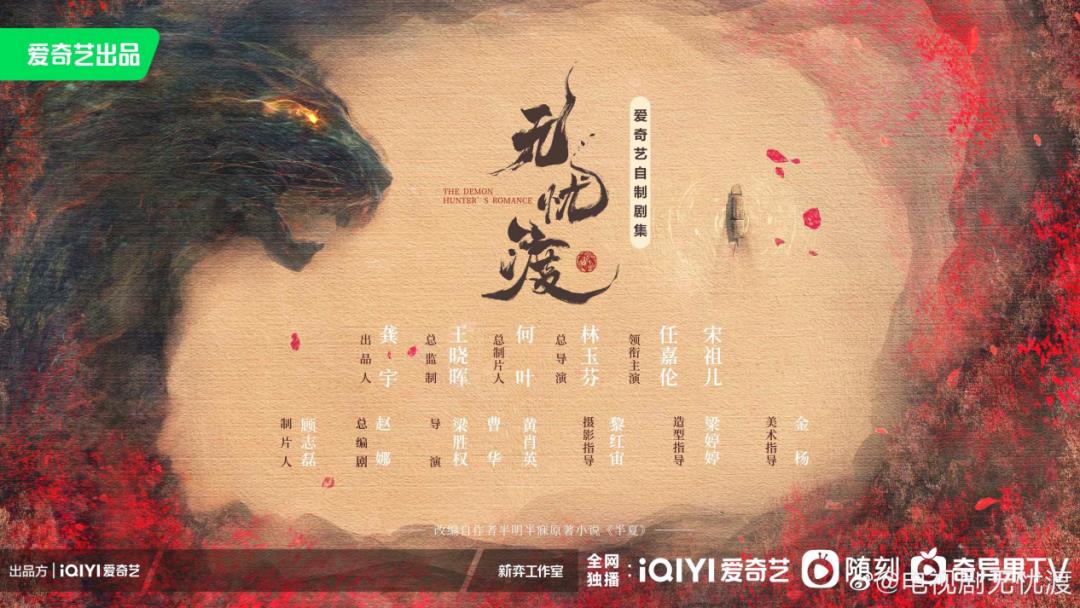
With Lin Yufen as the general director and Allen and lareina as the leading roles, the official lineup of the thriller romance "Worry-Free Crossing" was announced. The play is based on the novel Banxia, which is half-awake and half-awake. It tells the mysterious love story that the demon catcher Xuanye (played by Allen) meets the girl Banxia (played by lareina), and the two of them have a strange and unsolved case in the world where the shemale coexists. It is reported that the drama series will adopt the narrative form of the main line +6 strange stories to deeply depict the life in the strange world.

"Yue Ge Xing" released a concept preview.

Directed by Kin-lun Lam and starring Vin and LULU, the love drama "Moon Songs" in costume Xianxia recently released a concept preview. The play is adapted from shu ke’s novel "Running to the Moon", which tells the story of a young girl named Liu Shao (LULU) who has gone through all kinds of hardships to protect the whole life and her lover, and devoted her life to her promise. The protagonists strive to break through fate and are eager to change the ending, and in the process, they also gain growth, responsibility and love.

"New wrong sedan chair marries the right man"

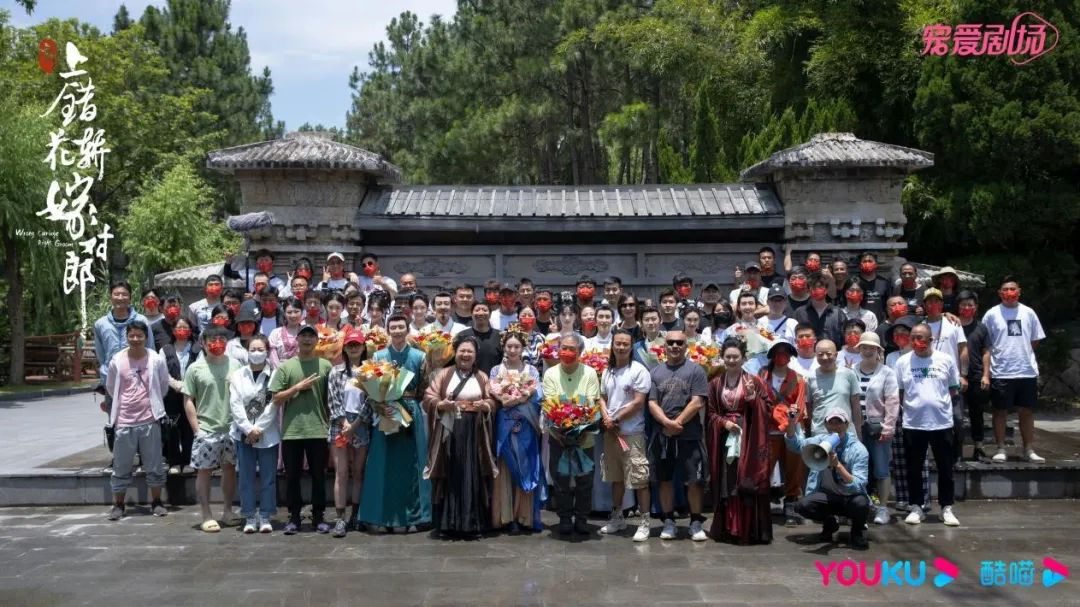
The costume drama "Bridging the Couple with the Wrong Bride" starring Tian Xiwei, Ao Ruipeng, Zhao Shunran and Bai Bing Ke has been officially finished recently. Based on Xi Juan’s novels "Getting on the wrong sedan chair to marry the right man" and "Please make do with it", the play tells a series of stories caused by two brides accidentally getting on the wrong sedan chair. The classic costume works are now remake again with a brand-new lineup. Whether there will be unexpected eye-catching performance is worth looking forward to.

The link you visited is about to leave the portal of the Ministry of Ecology and Environment. Do you want to continue?

  Off-road mobile machinery has a wide range of applications, including construction machinery, agricultural machinery, garden machinery, generator sets, fishery machinery and airport ground handling equipment, among which construction machinery and agricultural machinery account for the highest proportion. China Mobile Source Environmental Management Annual Report shows that in 2020, the NOx and PM emissions of these two types of machinery will reach 3.166 million tons and 168,000 tons respectively, accounting for 28% and 55% of the total emissions of mobile sources. In order to implement the Law on the Prevention and Control of Air Pollution and further strengthen the pollution prevention and control of off-road mobile machinery, in 2014, the Ministry issued the Emission Limits and Measurement Methods of Diesel Engine Exhaust Pollutants for Off-road Mobile Machinery (Phase III and IV in China) (GB 20891—2014), requiring the implementation of the third-stage emission standards on October 1, 2015. In January, 2021, based on the needs of environmental management and the situation of the industry, the Ministry revised and improved the technical requirements and implementation time of the fourth stage, and jointly issued a revised version of the fourth stage emission standards (hereinafter referred to as the National Four Standards) by the General Administration of Market Supervision, requiring the implementation of the National Four Standards on December 1, 2022.

China Banking and Insurance Regulatory Commission issued the Detailed Rules for the Implementation of the Measures for the Management of Non-life Insurance Business Reserves of Insurance Companies (No

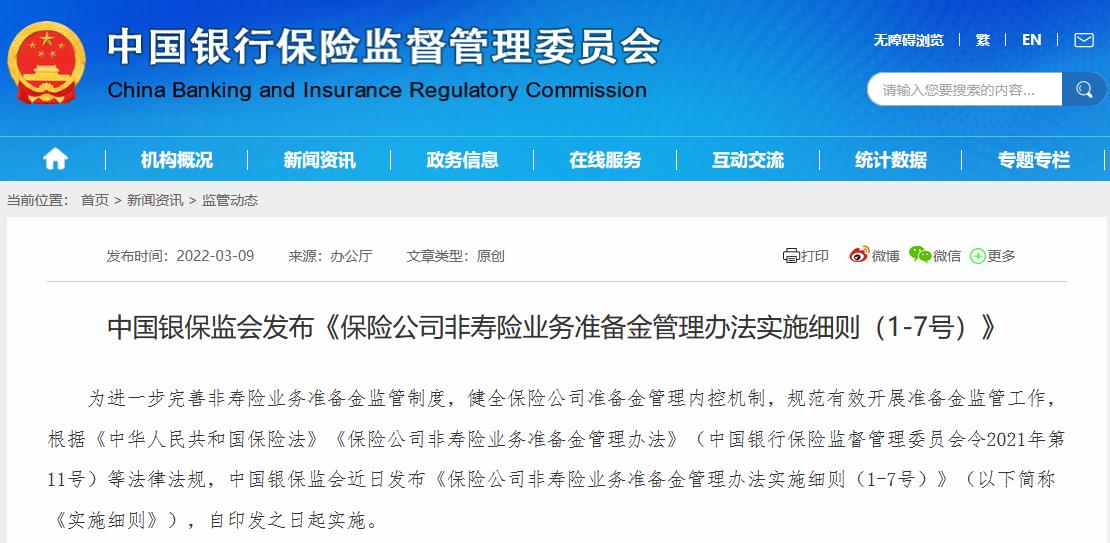
Cctv newsAccording to the website of China Banking and Insurance Regulatory Commission, in order to further improve the supervision system of non-life insurance reserves, improve the internal control mechanism of reserve management of insurance companies, and standardize and effectively carry out reserve supervision, according to the Insurance Law of People’s Republic of China (PRC), Measures for the Management of Non-life Insurance Reserves of Insurance Companies (Order No.11 of the Insurance Regulatory Commission of the Bank of China, 2021) and other laws and regulations, China Banking and Insurance Regulatory Commission recently issued the Implementation Rules for the Management Measures for Non-life Insurance Reserves of Insurance Companies (No.1-7) (hereinafter referred to as ").

The main contents of the Implementation Rules include: first, to clarify the principles and methods of reserve evaluation, and to standardize the reasonable methods and assumptions used in reserve evaluation of insurance companies; The second is to stipulate the internal control process of reserve evaluation. When the reserve evaluation of an insurance company changes and has a significant impact, it should perform the process of submitting a resolution to the company’s board of directors; The third is to standardize the handling of reserve risk margin and discount, stipulate that the method of calculating risk margin should not be changed at will once it is determined, and clarify the duration standard of discount when evaluating reserve; Fourth, strengthen the management of the reserves of insurance companies’ branches, requiring insurance companies to objectively and fairly reflect the operating conditions of branches and not to artificially adjust them; The fifth is to standardize the retrospective analysis of reserves, and clarify the specific rectification measures that insurance companies should take when the retrospective results of reserves of insurance companies are greatly deviated; The sixth is to clarify the contents of the reserve evaluation report, standardize the specific information to be disclosed and the expression of actuarial opinions, and require insurance companies to fill in the reserve supervision report; Seventh, improve the working paper system for reserve evaluation, standardize the management of the preparation, review and use of working papers, and require insurance companies to keep working papers for future reference as required.

The promulgation and implementation of "Detailed Rules for Implementation" has effectively improved the scientific, rational and systematic supervision system of non-life insurance business reserves, and provided institutional guarantee for further strengthening the management of non-life insurance business reserves. In the next step, China Banking and Insurance Regulatory Commission will guide and urge all insurance companies to conscientiously implement the Detailed Rules for Implementation, continuously improve the management level of non-life insurance business reserves, and promote the high-quality development of the insurance industry.

Notice of Guangzhou Municipal Bureau of Commerce on Printing and Distributing the Action Plan for Promoting Trade-in of Consumer Goods in Guangzhou

District People’s governments, municipal government departments and directly affiliated institutions:

  The "Guangzhou Action Plan for Promoting Trade-in of Consumer Goods" has been agreed by the Municipal People’s Government and is hereby issued to you. Please conscientiously implement it according to the actual situation. Please report the problems encountered in the implementation to the Municipal Bureau of Commerce.

Guangzhou Bureau of Commerce

June 17, 2024

Guangzhou’s Action Plan for Promoting Trade-in of Consumer Goods

  In order to thoroughly implement the relevant decisions and arrangements of the CPC Central Committee and the State Council, According to the Notice of the State Council on Printing and Distributing the Action Plan for Promoting Large-scale Equipment Renewal and Consumer Goods Trade-in (Guo Fa [2024] No.7), the Notice of the Ministry of Commerce and other 14 departments on Printing and Distributing the Action Plan for Promoting Consumer Goods Trade-in (Shang Consumer Development [2024] No.58) and the Notice of the General Office of the People’s Government of Guangdong Province on Printing and Distributing the Action Plan for Promoting Consumer Goods Trade-in (Guangdong)

  I. Guiding ideology and work objectives

  Focusing on Guangzhou’s task of accelerating the cultivation and construction of an international consumption center city, we will anchor the pursuit of "the vanguard, the leader and the locomotive", persist in deepening the structural reform on the supply side, focus on expanding the synergy of effective demand, conform to the new situation and trend of the consumer market, take standards as the traction, policies as the incentive and smooth circulation as the driving force, and promote more high-quality durable consumer goods to enter residents’ lives, and promote consumption to shift from post-epidemic recovery to continuous expansion.

  By grasping the opportunity of the state to encourage the promotion of trade-in of consumer goods, we will increase policy guidance and support, comprehensively promote the high-quality economic development of Guangzhou, and lead the implementation of new quality productivity. Strive to accelerate the elimination of passenger cars registered with emission standards of Grade III and below in the country of use by 2025, and further improve the utilization rate structure of energy-efficient new energy vehicles and hybrid vehicles; The standardized recycling and dismantling of scrapped cars in the city increased by 50% compared with 2023, reaching 72,000 vehicles. Further improve the recycling system and build 10 green sorting centers through new construction or upgrading. By 2027, the standard recycling and dismantling volume of scrapped cars in the city will increase by two times compared with that in 2023, reaching about 80,000 vehicles, accounting for more than 10% of the total recycling in the province. Reasonable layout of waste household appliances and other renewable resources recycling outlets, the city’s recycling outlets reached 3000, covering 100%.

  Second, carry out automobile trade-in.

  Starting from strengthening the construction of circular system of automobile industry and expanding automobile consumption, we should increase policy support, unblock circulation, and promote automobile consumption step by step and update consumption.

  (1) Increase financial and monetary policy support. Accelerate the implementation of the national automobile trade-in campaign, carry out the "scrapping and updating" activities of automobiles throughout the city, and organize qualified consumers to apply for subsidies through the "national unified automobile trade-in system". The city carried out the "replacement and renewal" activities of automobiles in the way of "government support and profit-making by enterprises", organized eligible consumers to apply for subsidies through the "unified automobile trade-in system in the city", and mobilized the whole city’s automobile manufacturers and dealers to superimpose car purchase concessions to make profits. Encourage financial institutions to increase the support of automobile consumption credit under the premise of legal compliance and controllable risks, and reasonably determine the down payment ratio, interest rate level and loan term of passenger car loans; Encourage financial institutions to optimize financial products and services to better support reasonable automobile consumption demand. Encourage insurance institutions to further enrich auto insurance products and services, optimize the pricing mechanism of new energy auto insurance, and provide effective and sufficient risk protection for consumers. (Municipal Finance Office, Municipal Development and Reform Commission, Municipal Bureau of Industry and Information Technology, Municipal Public Security Bureau, Municipal Finance Bureau, Municipal Bureau of Ecology and Environment, Municipal Bureau of Commerce, Municipal Market Supervision Bureau, Municipal Taxation Bureau, Guangdong Branch of the People’s Bank of China, and Guangdong Supervision Bureau of the State Financial Supervision Bureau are responsible for the division of responsibilities, which are implemented by the district governments. The following tasks need to be implemented by the district governments, and they will not be listed one by one.)

  (two) strict implementation of automobile scrap recycling standards. Strictly implement the provisions of motor vehicle scrapping standards and the requirements of vehicle safety and environmental protection inspection standards, strengthen the compliance inspection of vehicles driving on the road, strengthen the standardized inspection and verification of motor vehicle inspection stations, and eliminate old cars that meet the mandatory scrapping standards according to laws and regulations. On the basis of fully respecting the wishes of the masses, guide car owners to comprehensively consider fuel consumption, failure rate, maintenance cost, vehicle salvage value and scrapping renewal subsidies, and independently eliminate old cars that meet the standards for guiding scrapping. (The Municipal Bureau of Ecology and Environment, the Municipal Public Security Bureau, the Municipal Bureau of Commerce and the Municipal Market Supervision Bureau are responsible for the division of responsibilities)

  (3) Improve the recycling and dismantling system for scrapped motor vehicles. Guide the recycling and dismantling enterprises of scrapped motor vehicles to optimize the regional layout, support qualified enterprises to set up recycling service outlets according to their needs, improve the comprehensive recycling service platform, improve work efficiency, and build a four-level recycling and dismantling system of "owner-recycling outlets-dismantling enterprises-comprehensive resource utilization enterprises". Encourage scrapped motor vehicle recycling and dismantling enterprises to extend the industrial chain of downstream steel, non-ferrous metals and parts remanufacturing, and improve the comprehensive utilization capacity of resources. Encourage scrapped motor vehicle recycling and dismantling enterprises to expand the "internet plus Recycling" business with the help of relevant information platforms and mobile applications, and guide and promote the use of the "Guangzhou Traffic Police" WeChat official account reservation motor vehicle recycling system to facilitate car owners to sell scrapped cars and choose qualified scrapped automobile enterprises in this city for recycling. Strengthen the coordinated supervision of departments, standardize the business behavior of scrapped motor vehicle recycling and dismantling enterprises through inspection methods such as "double random, one open" and "four no two straight", continuously intensify efforts to crack down on illegal dismantling activities, and maintain the development order of the industry. Supervise and urge enterprises to implement the pre-recycling nuclear file mechanism to prevent vehicles from being cancelled normally due to illegal or mortgaged reasons. Continue to carry out the identification of green development enterprises for the recycling and dismantling of scrapped motor vehicles. (The Municipal Bureau of Industry and Information Technology, the Municipal Public Security Bureau, the Municipal Bureau of Planning and Natural Resources, the Municipal Bureau of Ecology and Environment, the Municipal Bureau of Commerce and the Municipal Market Supervision Bureau are responsible for the division of responsibilities)

  (4) Improve the service level of second-hand car circulation. We will continue to implement convenient measures to support the circulation and trading of used cars. For automobile sales enterprises that have been filed on the unified platform of the business system of the Ministry of Commerce to purchase used cars from natural persons, enterprises are allowed to issue unified invoices for used car sales in reverse and handle the transfer registration procedures accordingly. Actively promote the establishment of motor vehicle registration service stations in qualified second-hand car distribution enterprises, improve supporting services, and provide consumers with "one-stop" services such as trading, tax payment, registration and insurance. Encourage automobile manufacturers to develop and build a testing platform for new energy used car power batteries to ensure the performance and safety of new energy used car batteries. Guide the second-hand car distribution enterprises to provide a display vehicle condition table, express the basic information, price, important configuration and other contents of the vehicle, and promote the safe trading and honest management of second-hand cars. (The Municipal Bureau of Industry and Information Technology, the Municipal Public Security Bureau, the Municipal Bureau of Commerce and the Municipal Taxation Bureau are responsible for the division of responsibilities)

  (5) Further promote the export of used cars. Implement the "Several Measures for Guangzhou to Further Improve the Export Facilitation of Used Cars and Promote the High-quality Development of Foreign Trade", and improve the level of facilitation in vehicle transaction registration, license application, port customs clearance, vehicle cancellation, export tax rebate and other links. Encourage automobile production and circulation enterprises to carry out second-hand car export business and support qualified enterprises to build a comprehensive service base or platform for second-hand car export. Encourage enterprises to explore the international market, build marketing networks and after-sales service outlets in major target markets, and guide the after-sales supporting industrial chain to the sea. Increase support for export services and finance, give full play to the role of professional organizations such as trade associations, strengthen policy propaganda and practical business guidance, and give practical and effective support in overseas market compliance and industry information. (The Municipal Bureau of Industry and Information Technology, the Municipal Public Security Bureau, the Municipal Bureau of Transportation, the Municipal Bureau of Commerce, the Municipal Taxation Bureau and the Guangzhou Customs of the General Administration of Customs are responsible for the division of responsibilities)

  (6) Cultivate and expand the business entities of used cars. Promote the regulation of the main body of the second-hand car sales market, and give certain rewards to the second-hand car sales enterprises that reach the threshold of the regulation and complete the first statistical data submission. Encourage automobile production enterprises to carry out second-hand car replacement and manufacturer certification, and guide second-hand car distribution enterprises to make good use of the reverse invoicing policy, and change from "brokerage mode" to "distribution mode" to standardize their operations and become bigger and stronger. Give full play to the role of industry associations, strengthen policy propaganda and related business guidance, and accelerate the construction of compliance system for used car industry. (The Municipal Bureau of Industry and Information Technology, the Municipal Public Security Bureau, the Municipal Bureau of Commerce, the Municipal Market Supervision Bureau and the Municipal Taxation Bureau are responsible for the division of responsibilities)

  (seven) to further promote the innovation and development of automobile consumption. Promote the green consumption of automobiles, increase the incremental indicators of energy-saving vehicles and relax the qualifications for non-local household registration personnel to apply for incremental indicators of energy-saving vehicles. Further improve the infrastructure such as charging, parking and intelligent transportation, accelerate the upgrading of charging facilities such as residential communities, parking lots, expressway service areas and passenger transport hubs, guide the rational optimization of layout, and improve the convenience of charging. Expand the supply of parking spaces in cities, and further improve the supply level of parking spaces for residential construction projects according to the requirements of Guangzhou Construction Project Parking Spaces Allocation Index Regulations. Improve the information sharing mechanism between departments and promote the public use of non-confidential and non-private information in the automotive field. Guide enterprises to carry out automobile maintenance, modification, leasing and cultural events according to laws and regulations, and create a number of influential and dynamic automobile aftermarket projects. (Municipal Bureau of Industry and Information Technology, Municipal Public Security Bureau, Municipal Transportation Bureau, Municipal Bureau of Commerce, Municipal Taxation Bureau, Municipal Bureau of Planning and Natural Resources, Municipal Housing and Urban-Rural Development Bureau, Municipal Bureau of Culture, Radio, Film and Television Tourism, and Municipal Sports Bureau are responsible for the division of responsibilities)

  (eight) to create a car to promote consumption boom. Mobilize industry associations, automobile production and distribution enterprises, news media, financial institutions, used car enterprises, automobile modification enterprises, etc. to participate in online and offline linkage, and encourage cross-industry innovation and integration to hold automobile-related theme activities around automobile culture, events, go on road trip, car experience, new car tasting and other hot spots in the automobile industry. Encourage all districts to continue to hold automobile consumption festivals and set off an automobile consumption boom. Actively use all kinds of media channels, focus on automobile consumption promotion policies and activities, increase publicity and promotion, and stimulate consumers’ willingness to buy cars. (The Municipal Bureau of Culture, Radio, Film and Television Tourism, the Municipal Sports Bureau, the Municipal Bureau of Commerce, the Municipal Bureau of Industry and Information Technology, and the Propaganda Department of the Municipal Party Committee are responsible for the division of responsibilities)    

  Third, carry out the trade-in of home appliances

  Highlight the improvement of the household appliance trade-in cycle system. It is convenient for residents to deliver used household appliances, improve the recycling system of used household appliances, open up the blocking points of household appliances recycling, encourage green, intelligent and low-carbon household appliances to be replaced with new ones, and smooth the consumption cycle of household appliances renewal.

  (nine) to carry out the activities of household appliances to benefit the people. Organize the city’s green smart home appliance replacement activities, and subsidize consumers to deliver used home appliances and buy new green smart home appliances. We will mobilize enterprises producing and selling household appliances, industry associations and financial institutions to participate in many ways, encourage enterprises to make profits by overlapping, guide financial institutions to launch green smart household appliances consumption financial products under the premise of legal compliance and controllable risks, tailor-made exclusive consumer credit schemes for consumers, and encourage the rational development of special financing products such as preferential interest rates and flexible staging. (The Municipal Finance Office, the Municipal Bureau of Industry and Information Technology, the Municipal Finance Bureau, the Municipal Bureau of Commerce, and the Guangdong Supervision Bureau of the State Financial Supervision Bureau are responsible for the division of responsibilities)

  (10) Increase policy support. On the basis of implementing the current relevant tax policies, we will implement the reverse billing policy for those who sell waste household appliances to natural persons by resource recycling enterprises. Encourage financial institutions to increase investment and financing support for enterprises and key projects related to waste household appliances recycling and household appliances trade-in. Guide financial institutions to provide targeted financial services for enterprises producing and selling green, intelligent and low-carbon household appliances, and increase financial support for small and medium-sized enterprises. Guide all districts to bring waste household appliances recycling facilities into the scope of local public infrastructure land, and ensure the reasonable land demand and the long-term and stability of land use. (Municipal Finance Office, Municipal Planning and Natural Resources Bureau, Municipal Taxation Bureau, Guangdong Branch of the People’s Bank of China, and Guangdong Supervision Bureau of the State Financial Supervision Bureau are responsible for the division of responsibilities)

  (eleven) optimize the recycling system of used household appliances. Improve the recycling system of renewable resources such as used household appliances, take the convenience of urban and rural residents to sell used household appliances as the core, combine the different characteristics of cities and rural areas, make full use of recycling outlets, "two networks integration" outlets, street (town) transfer stations and green sorting centers, and rationally arrange the recycling system. Encourage recycling enterprises to "extend their tentacles" and promote professional and standardized recycling services into the streets and communities. Cultivate leading enterprises in recycling renewable resources such as waste household appliances, support industry associations to recommend the list of waste household appliances recycling enterprises, and cooperate with enterprises such as home appliance manufacturers, supermarkets and e-commerce platforms to carry out waste household appliances recycling services. Typical cities applying for recycling system of renewable resources such as used household appliances will further improve the recycling system of used household appliances through typical exploration and point-to-point, and give encouragement and support to typical enterprises evaluated by the Ministry of Commerce. (The Municipal Bureau of Commerce, the Municipal Urban Management Comprehensive Law Enforcement Bureau and the Municipal Supply and Marketing Federation are responsible for the division of responsibilities)

  (twelve) increase the cultivation of diversified recycling subjects. Guide home appliance manufacturers to implement the extended producer responsibility system, and actively mobilize enterprises to participate in the second batch of home appliance manufacturers to recycle the target responsibility system. Encourage home appliance manufacturers, supermarkets, e-commerce platforms and other enterprises to strengthen cooperation with recycling enterprises, and carry out waste home appliances recycling while selling new home appliances. Encourage the supply and marketing system to give full play to the advantages of the business service network, and actively participate in activities such as home appliances going to the countryside and trade in old ones. Support recycling enterprises to carry out "internet plus recycling" with the help of information platforms and mobile applications. Encourage enterprises to strengthen industry self-discipline and independent innovation, chain operation, agreement cooperation, etc., to implement chain operation, standardization and standardization, and cultivate a number of leading recycling enterprises. (The Municipal Bureau of Industry and Information Technology, the Municipal Bureau of Commerce and the Municipal Supply and Marketing Corporation are responsible for the division of responsibilities)

  (thirteen) to strengthen the support of household appliances standards. Encourage enterprises to lead and participate in the formulation of relevant international standards for smart home appliances and core components, and improve the internationalization level of products. Guide household appliance manufacturers to increase the supply of green, intelligent and low-carbon household appliances in accordance with relevant standards, and promote industrial upgrading and product green transformation. Guide household appliance manufacturers and industry associations to compile the catalogue of safe service life of products, widely publicize the safety risks of used household appliances and the environmental protection problems of high-energy-consuming household appliances, publicize the suggestions on the service life of household appliances, and guide the accelerated upgrading of used household appliances. Support renewable resources industry associations and recycling enterprises to initiate and participate in the revision of relevant standards, make good use of relevant standards, and carry out standardized and standardized recycling. (The Municipal Bureau of Industry and Information Technology, the Municipal Market Supervision Bureau and the Municipal Bureau of Commerce are responsible for the division of responsibilities)

  (fourteen) smooth the circulation channels of second-hand goods. Encourage production and circulation enterprises such as electrical and electronic products to develop second-hand recycling business and expand the scale of second-hand commodity transactions. Promote the standardized construction and operation of offline entity second-hand market according to local conditions. Encourage the development of "internet plus second-hand" and after-sale repurchase models, and cultivate a number of leading enterprises in the circulation of second-hand commodities with convenient service, standardization and high efficiency. Strengthen the supervision and management of second-hand commodity trading enterprises, business behavior and market order, standardize the trading behavior of second-hand commodities, support the establishment of second-hand commodity industry organizations, encourage second-hand commodity trading enterprises to carry out industry self-discipline, establish recycling information ledger and sales registration, and do a good job in popularizing the knowledge of recovering stolen goods. (The Municipal Bureau of Industry and Information Technology, the Municipal Bureau of Commerce, the Municipal Public Security Bureau and the Municipal Market Supervision Bureau are responsible for the division of responsibilities)

  (15) Improve the after-sales service level in an all-round way. In-depth implementation of home appliance after-sales promotion actions, and continue to select a number of leading enterprises in home appliance after-sales service. Guide after-sales enterprises such as home appliance repair to expand service coverage. Organize home appliance after-sales service enterprises and recycling enterprises to strengthen cooperation and jointly improve the service level. Guide relevant industry associations and enterprises to introduce home appliance service standards and promote the standardized development of services. (The Municipal Bureau of Industry and Information Technology, the Municipal Bureau of Commerce and the Municipal Market Supervision Bureau are responsible for the division of responsibilities)

  Fourth, promote the "rejuvenation" of home improvement kitchen and bathroom

  Highlight the expansion of renovation and renovation of stock houses, promote the replacement of home-improvement kitchen and bathroom consumer goods, foster new growth points of green smart home consumption, and continuously release the potential of home consumption.

  (sixteen) increase policy support. Encourage qualified districts to support residents to carry out renovation of old houses, local renovation of kitchens and bathrooms and aging renovation of homes, and subsidize the purchase of green smart home products such as green intelligent furniture and green building materials. Combined with the work related to the basic old-age service in the home community, we will cultivate the main body of home aging transformation and drive more families to carry out aging transformation. Guide financial institutions to develop financial products for the "rejuvenation" of home improvement and kitchen, and reasonably determine the repayment method, term and loan amount under the premise of legal compliance and risk control. Simplify the approval process for home improvement companies to start work, and facilitate residents to handle family decoration procedures. (Municipal Finance Office, Municipal Housing and Urban-Rural Development Bureau, Civil Affairs Bureau, Guangdong Branch of the People’s Bank of China, and Guangdong Supervision Bureau of the State Financial Supervision Bureau are responsible according to the division of responsibilities)

  (seventeen) the development of community convenience services. With the help of the pilot work of the city’s 15-minute convenience living circle, property service enterprises are encouraged to set up "home improvement convenience service points" to provide temporary storage of furniture, home improvement market information consultation and other services to facilitate residents’ housing decoration. Guide leading home improvement enterprises to carry out special home improvement promotion activities for old communities. Guide residential property service enterprises to provide convenience for decorating vehicles, recycling vehicles and other vehicles entering and leaving the residential area. Support enterprises to provide home consumer goods, such as furniture, kitchen and bathroom, with the services of "sending new products" and "collecting old products", and promote the "internet plus recycling" model to meet the diverse needs of the masses. (The Municipal Development and Reform Commission, the Municipal Housing and Urban-Rural Development Bureau and the Municipal Bureau of Commerce are responsible for the division of responsibilities)

  (eighteen) to cultivate new growth points of green smart home consumption. Support enterprises to produce marketable green smart home products around the new scene of home consumption. Accelerate the construction of digital home and develop relevant standards for digital home. Encourage relevant industry associations to speed up the production, certification and popularization and application of green building materials. Encourage home improvement enterprises to launch online and offline home improvement model rooms, and promote model rooms to enter shopping malls, communities and platforms. (The Municipal Bureau of Industry and Information Technology, the Municipal Housing and Urban-Rural Development Bureau and the Municipal Market Supervision Bureau are responsible for the division of responsibilities)

  (nineteen) standardize the market order. We will crack down on counterfeiting, cutting corners and price fraud in the fields of home improvement and home consumption according to law. Incorporate the home improvement and home furnishing industries into the selection activities of typical cases of developing business with integrity in Guangdong Province, and recommend to declare the typical cases of "developing business with integrity" in China. Encourage home improvement industry associations to explore the implementation of the industry "blacklist" system, formulate home improvement acceptance standards, and guide market players to operate in good faith. Guide home improvement enterprises to strengthen the training of employees and improve the quality of after-sales service. (The Municipal Market Supervision Bureau, the Municipal Human Resources and Social Security Bureau, the Municipal Housing and Urban-Rural Development Bureau and the Municipal Bureau of Commerce are responsible for the division of responsibilities)

  V. Organizational guarantee    

  (twenty) to strengthen organizational leadership. The Municipal Bureau of Commerce, the Municipal Finance Bureau, and the Municipal Bureau of Industry and Information Technology will take the lead in promoting the implementation of work tasks in conjunction with relevant departments, strengthen work coordination, establish a work contact system, study major problems encountered in the trade-in of consumer goods, and assign special personnel to take charge of related work and solve problems in time. All departments should attach great importance to the trade-in of consumer goods, clarify work objectives, strengthen urban linkage, refine the division of tasks, compact responsibilities at different levels, and do a good job in implementation.

  (twenty-one) to strengthen the protection of funds and factors. All relevant departments take the initiative to connect with the relevant policies and funds of the central and provincial governments, strengthen reporting to the higher authorities on the actual situation of our city, and actively strive for policies and financial support for trade-in of various consumer goods. Provide land support for the construction of recycling system of automobiles and household appliances according to laws and regulations, and provide technical and data support for automobile sales invoice data, scrap automobile recycling certificate and automobile registration information needed for trade-in activities of consumer goods.

  (twenty-two) to promote overall activities. Implement the relevant arrangements of "Consumption Promotion Year", actively hold consumption festivals and themed consumption promotion activities around the themes of automobiles, household appliances, home furnishing and home improvement, organize industry associations, production enterprises, distributors, financial institutions and insurance institutions to participate together, carry out joint profit-making promotion activities, form a policy combination boxing, stimulate market vitality, guide industry orderly competition, and create a fiery consumption atmosphere.

  (twenty-three) to strengthen publicity and guidance. Publish information on the trade-in policy of consumer goods through the official media. Give play to the role of various media platforms, industry associations and institutions, strengthen policy publicity and interpretation at multiple levels and through multiple channels, and expand policy influence and coverage.

  (twenty-four) to strengthen supervision and implementation. All relevant departments should formulate implementation plans according to specific work arrangements. All districts should earnestly do a good job in compliance guidance for the trade-in of consumer goods, strengthen risk prevention and control, and prevent local protection and enterprises from taking the opportunity to raise prices. It is not allowed to require the designated enterprises to sell used cars and household appliances, and it is not allowed to set up a subsidy catalogue with regional and technical product directionality.

Bath Buddy box office broke the exposure of 300 million Peng Yuchang "AI Face Change" fragment.


1905 movie network news As of press time, the cumulative box office of comedy movies has exceeded 300 million yuan, occupying the champion of single-day box office and film scheduling list for 7 consecutive days, leading the Lunar New Year file.

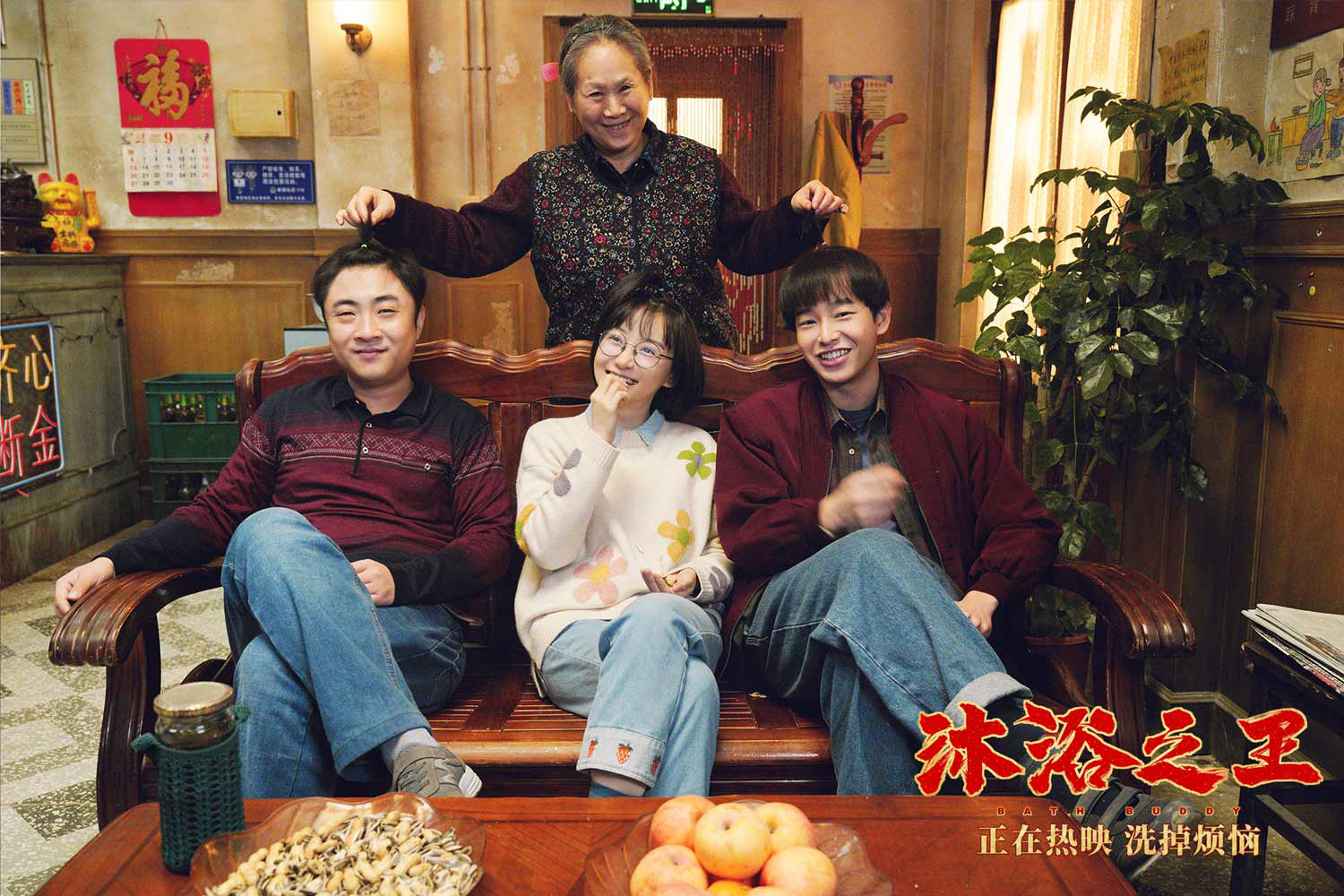
Today (December 19th), the film exposed the feature footage of "artificial face changing", the special effects of Peng Yuchang’s powerful acting performance, and Qiao Shan’s routine full of jokes, which aroused the enthusiasm of the audience to "brush again". The film Bath Buddy is directed by Xiaoxing Yi, starring Peng Yuchang and Qiao Shan, starring Guanjin Bu and Wei Qing, and starring Jin Shijia in friendship. The film is being shown.


Bath Buddy box office broke the 300 million yuan mark.

Peng Yuchang’s "artificial face change" made the audience laugh. 

Qiao Shan’s "Bathhouse Brothers"


In the "Artificial Face Change" released this time, Zhou Donghai played by Qiao Shan continued to be his younger brother for "Routine" Peng Yuchang, and came up with a video of Xiao Xiang and the family life in the bathhouse by artificial face change. From Guanjin Bu’s large-scale double-bidding scene of Xixi’s "little brother" Xiao Xiang and his brother Zhou Donghai, to Xiao Xiang’s "face-changing" video with consistent body movements and situations, and Zhou Donghai’s "caring for Han Han’s younger brother" eyes, many viewers were deeply impressed and felt "laughing" in succession.


Peng Yuchang watched the face-changing video and was routine by Qiao Shan.

Unexpectedly, the video of Xiao Xiang’s face changing on Xixi’s birthday was not made with special effects, but was performed by Peng Yuchang himself. "When watching the feature film, I thought it was late P, and the whole theater was full of laughter." Peng Yuchang was praised as "hand-changing face", which surprised the audience. Some viewers even entered the magnifying glass viewing mode when they brushed two times and three times, and carefully observed the details of "changing face", which showed the ingenuity and intention of the film’s master.


Peng Yuchang, Qiao Shan, Guanjin Bu and Wei Qing have a happy family.

Bathhouse family warms, heals and transmits strength. 

Bath Buddy Huo Tap Water Crazy Amway


Bath Buddy, a comedy film, tells the laughing story that Xiao Xiang, played by Peng Yuchang, changed from a playboy to a bathing worker after his accidental amnesia, and under the guidance of Zhou Donghai, played by Qiao Shan, practiced his bathing skills hard, hoping to become a generation of "king of bathing". The clip of "Artificial Face Changing" released today is not only another successful case of Zhou Donghai’s "routine" Zhou Jixiang, but also presents the warm picture of the bathhouse family living together in a comedy way. And Zhou Donghai’s video for "Routine" brother is exactly what Zhou Jixiang expects from his family.


Bath Buddy stills

Under the cloak of comedy, movies are the emotional core that makes people feel warm, and the movie-watching experience of "being happy, warm-hearted, and laughing at ease" has gained many audiences’ "tap water" Amway. Hand-painted bathhouse brothers’ Q version image, in-depth interpretation of the details of movie eggs, and bathing enterprises’ group viewing … … The audience’s fancy ways of calling are endless, which helps topics such as "The King of Bath’s box office broke 100 million yuan", "The King of Bath’s box office broke 200 million yuan" and "The King of Bath’s feature film fragment" to get the scores of call’s Eye 8.8 and Taobao Film 8.7, leading the New Year’s Eve file, and setting off an upsurge of punching in the "Brothers Bathroom" this winter.


Bath Buddy stills

The film Bath Buddy is directed by Xiaoxing Yi, starring Peng Yuchang and Qiao Shan, starring Guanjin Bu and Wei Qing, and starring Jin Shijia. The film is being shown all over the country, washing away troubles and welcoming the new year happily.


Notice on Issuing the Outline of the Pearl River Delta Environmental Protection Plan (2004-2020)

  I. Environmental Status and Challenges (1)

  (A) partial improvement, the situation is still grim (1)

  (2) The environment is overwhelmed and development faces challenges (2)

  Second, the planning principles and objectives (3)

  (1) Guiding ideology (3)

  (2) Planning Principles (3)

  (3) Planning objectives (4)

  Third, the strategic task (5)

  (A) red line control, optimize the regional spatial layout (5)

  1. Building a regional ecological security system (5)

  2. Optimize the security pattern of water environment (7)

  3. Establish the sensitive area of atmospheric environment (14)

  (2) The Green Line will be upgraded to guide the sustained economic development (14)

  1, promote ecological agriculture (15)

  2. Developing Eco-industry (16)

  3. Promoting Eco-tourism (19)

  4, promote sustainable consumption (20)

  (3) Blue Line Construction to Ensure Environmental Safety (22)

  1, focus on solving the problem of water pollution (22)

  2, improve the quality of regional atmospheric environment (24)

  3, prevention and control of solid waste environmental pollution (25)

  IV. Safeguards (27)

  (A) the implementation of comprehensive decision-making, strengthen regional coordination (28)

  1, establish and improve the comprehensive decision-making mechanism (28)

  2. Strengthen regional coordination and strictly unify regional environmental protection requirements (28)

  3, deepen the environmental protection assessment system (28)

  (2) Establish an environmental protection mechanism with government leading, market promotion and public participation (29)

  1, clear government responsibilities (29)

  2, strengthen policy guidance (29)

  3, the establishment of environmental information disclosure system (29)

  4, promote the progress of environmental science and technology (29)

  5. Encourage public participation (30)

  (3) Reform the environmental management system and improve the efficiency of environmental management (30)

  1, strengthen the construction of environmental protection institutions (30)

  2, strengthen the environmental management of villages and towns (31)

  3. Improve the modernization level of environmental protection management (31)

  (4) Increase investment in environmental protection and pay special attention to the construction of key projects (32)

  1. Broaden financing channels for environmental protection (32)

  2, focus on the five major construction projects (32)


  I. Environmental Status and Challenges

  (A) partial improvement, the situation is still grim.

  After more than 20 years of development, the social and economic development in the Pearl River Delta region has made remarkable achievements. In 2002, the Pearl River Delta, covering 0.4% of the country’s land area, gathered 3% of the country’s population and created nearly 9% of the country’s GDP. At the same time of rapid economic development, great progress has been made in environmental protection and ecological construction, and the comprehensive improvement of the Pearl River has achieved initial results. The water quality of the urban reach has been improved, and soot pollution has been initially controlled, but the overall environmental situation is still grim, mainly as follows:

  Although the water quality of the main and mainstream waterways in the Pearl River Delta has basically maintained a good level of Class II and III, the length of the polluted rivers is still increasing due to the large discharge of domestic wastewater, concentrated industrial sewage discharge and serious pollution of livestock and poultry breeding. The water quality of most urban river sections and rivers is seriously polluted, and the water bodies in some river sections are worse than Class V, which affects the life and production of coastal residents. Regional water supply and drainage crisscross, the water quality of drinking water sources in some cities is affected, and cross-regional water pollution is becoming increasingly prominent. The advantage of abundant regional water resources is changing to the disadvantage of water shortage.

  The frequency of acid rain in the Pearl River Delta is still high, forming a high-incidence area of acid rain with Guangzhou and Foshan as the center. The ratio of nitrogen oxides to sulfur dioxide in each city is increasing, and the air pollution caused by motor vehicle exhaust, which is characterized by nitrogen oxides pollution, has become increasingly prominent, showing signs of photochemical pollution and forming a phenomenon of regional air composite pollution.

  The ecological land in the Pearl River Delta has been heavily occupied, the primary forest and natural secondary forest have been destroyed, some key ecological transition zones, nodes and corridors have not been effectively protected, the regional natural ecosystem has been obviously fragmented, and there is a lack of regional controlled ecological protection system. The phenomenon of indiscriminate hunting, indiscriminate digging and indiscriminate mining has been repeatedly banned, and the number and species of wild animals and plants have plummeted, which has seriously threatened biodiversity. Forest biomass and net production are not high, and forest ecological benefits are low. The amount of pesticide and chemical fertilizer used per unit land area is higher than the national average, nitrogen fertilizer pollution, pesticide residues and persistent organic pollution are aggravated, the agricultural ecological environment is deteriorating, the regional ecological quality is declining, and the ecological deficit is serious. 

  The comprehensive decision-making mechanism of economic development and environment in the Pearl River Delta needs to be strengthened, and there is still a phenomenon of emphasizing economy over environmental protection in some areas. The ability of environmental management at county and town levels is weak, and the mode and ability of environmental supervision can not meet the requirements of the new situation. The investment in environmental protection, especially the direct investment in sewage and garbage treatment and ecological construction, is insufficient, the construction of environmental protection infrastructure is lagging behind for a long time, and the debts are serious, forming a situation of "pollution first and then treatment". The difference and imbalance between environment and socio-economic development gradually appear, and resources and environment have become the "short board" of sustainable development, which restricts the overall competitiveness of urban agglomerations in the Pearl River Delta and the sustainable development of the region in the future.

  (2) The environment is overwhelmed and development is facing challenges.

  The Ninth Party Congress of Guangdong Province and the Second Plenary Session of the Ninth Provincial Party Committee have set the goal for the future. By 2010, the per capita GDP of Guangdong Province will double that of 2000, and the Pearl River Delta will take the lead in basically realizing socialist modernization. By 2020, the province’s per capita GDP will double that of 2010, build a well-off society in an all-round way, and take the lead in basically realizing socialist modernization. This goal puts forward higher requirements for environmental protection, and the tasks of environmental protection and ecological construction are more arduous.

  According to the forecast, in 2010 and 2020, the output of wastewater and water pollutants will increase by 60% and 100% respectively compared with that in 2002, and the emissions of sulfur dioxide, nitrogen oxides and inhalable particulate matter (PM10) will also increase greatly, and the total output of solid waste will increase by 50% and 80% respectively. All these will cause great pressure on the environment of the Pearl River Delta in the future. At present, the overdrawn environmental capacity and resources cannot support the extensive economic development model, and the Pearl River Delta will face severe challenges from many old and new environmental problems. 

  Second, the planning principles and objectives

  (A) the guiding ideology

  Guided by Theory of Three Represents and Scientific Outlook on Development, around the goal of basically realizing socialist modernization in the Pearl River Delta, with the aim of improving people’s living standards and improving environmental quality, we should pay equal attention to pollution prevention and ecological protection, develop circular economy, promote clean production, advocate ecological civilization, take the development road of production development, affluent life and good ecology, and promote the coordinated development of economy, society and environment.

  (2) Planning principles

  People-oriented, environment first: adhere to the principle of people-oriented and harmony between man and nature, change the mode of economic growth, support the sustainable development of social economy with the sustainable utilization of environmental resources, effectively improve environmental quality and ensure regional environmental safety.

  Overall planning and coordinated development: in accordance with the requirements of the "five overall plans", take the road of new industrialization, rationally plan and distribute towns and industries, develop circular economy and promote clean production. Solve environmental problems from the perspective of the whole region and realize the coordinated development of the region.

  Focus on the future and plan scientifically: focus on the sustainable development of the Pearl River Delta in the future, comprehensively analyze the restrictive factors of the coordinated development of economy, society and environment in the future, face up to the gap between the current environmental situation and the requirements of taking the lead in basically realizing the goal of socialist modernization, explore new ideas and plan new development. 

  Improve the mechanism and strengthen regulation: strengthen the leading role of the government in environmental protection, clarify responsibilities, implement grading objectives and tasks, establish mechanisms, take measures, rationally and effectively allocate public resources, and promote the coordinated development of social economy and environment. 

  (3) Planning target 

  The overall goal of the planning is to build the Pearl River Delta into a comprehensive and coordinated sustainable development demonstration area.

  By 2010, environmental pollution and ecological destruction have been effectively controlled, the discharge of major pollutants has been greatly reduced, the water quality of the trunk and tributaries of the Pearl River Delta water system has maintained a good level, the frequency of acid rain has dropped significantly, and the comprehensive environmental protection index of each city has reached more than 90 points. All cities have met the requirements of national environmental protection model cities and built national environmental protection model urban agglomerations.

  By 2020, the security pattern of ecological environment will be basically formed, the circular economy system will be gradually improved, and the ecological environment will be virtuous. All cities will meet the requirements of eco-city and build eco-city groups. 

  III. Strategic tasks

In the process of modernization of the Pearl River Delta in , three strategic tasks should be completed: red line regulation, green line promotion and blue line construction. 

 (1) Red Line Regulation and Optimization of Regional Spatial Layout

 1. Building a regional ecological security system.

 (1) Ecological function zoning of 

  According to the sensitivity of regional ecological environment, the importance of ecological service function and the difference of regional socio-economic development direction, the Pearl River Delta is divided into three first-class ecological functional zones, namely, circular mountain forest ecological security barrier zone, delta plain agricultural metropolis economic zone and southern coastal ecological protection zone, seven second-class ecological functional zones, namely, western ecological protection and biodiversity protection zone, 75 third-class functional zones on land and five third-class functional zones, namely, Dashahe reservoir water conservation zone. 

  (2) Constructing regional ecological structure system

  Protect, nurture and restore large-scale natural patches and wetlands, protect relatively isolated regional natural ecosystem reserves, and build a structural ecological control area in the regional ecosystem; Maintain continuous mountains and river trunk roads, establish a perfect protection system along traffic trunk roads and economic corridors, and form an ecological channel connecting various structural ecological control areas in the region; Strengthen the protection and restoration of isolated mountain green spaces between urban agglomerations to form a green core of urban agglomerations; Maintain the intersections and fragile points of each ecological channel and protect the key nodes of the regional ecological structure system; Protect the small natural patches left in large urban landscapes and strengthen the ecological regulation of urban construction. A regional ecological structure system with 18 nodes, 16 channels, 6 districts and 6 cores will be built. 

  (3) Protecting , an important and sensitive ecological area.

  Protect water conservation areas. Rationally adjust and optimize the industrial structure and layout of water conservation areas, strictly control water pollution sources, and strengthen ecological cultivation and construction. 

  Construction of nature reserves. The proportion of nature reserves in the land area has increased steadily. By 2010, 15 nature reserves will be built, 9 nature reserves will be upgraded (3 at the national level and 6 at the provincial level) and 4 nature reserves will be expanded, including the upgrading and expansion of municipal nature reserves. There are 93 nature reserves in the whole region, with a total area of about 401,000 hectares, accounting for 6.3% of the land area. 

  Protect the ecological environment of estuaries and coastal waters. By 2010, the water quality in coastal waters will basically meet the requirements of environmental functional zones, with emphasis on strengthening the marine ecological environment protection in Daya Bay-Dapeng Bay, Guangzhou-Wanshan Islands, Zhuhai-Taishan Chixi Peninsula and Chuanshan Islands estuary. 

  Harness soil erosion. By 2010, the control rate of natural soil erosion will reach more than 80%, and all steep cultivated land with a slope greater than 25 degrees will be returned to forest and grassland, and man-made soil erosion will be controlled. 

  (4) Implementing ecological protection and grading control of .

  According to the strict requirements for ecological protection, the Pearl River Delta is divided into strict protection areas, controlled protection and utilization areas and guided development and construction areas as the basis of regional ecological protection and management. 

  Strictly protected areas: including the core areas of nature reserves, key water conservation areas, coastal zones, extremely sensitive areas of soil erosion, primary ecosystems, ecological public welfare forests and other important and sensitive ecological functional areas, covering an area of about 5,058 square kilometers, accounting for 12.13% of the total land area of the Pearl River Delta. Governments at all levels should classify these areas as red lines and implement strict protection.

  Controlled protection and utilization area: including important ecological function control area, ecological conservation area, ecological buffer area, etc., covering an area of about 17,483 square kilometers, accounting for 41.93% of the total land area of the Pearl River Delta. The controlled protection and utilization area can be developed and utilized moderately, but it must be ensured that the development and utilization will not lead to the decline of environmental quality and the damage of ecological function, and at the same time, active measures should be taken to promote the improvement and improvement of regional ecological function. 

  Guiding development and construction area: it mainly includes guiding resource development and utilization area and urban construction and development area, covering an area of about 19,157 square kilometers, accounting for 45.94% of the total land area of the Pearl River Delta. Guiding resource development and utilization areas should reduce the amount of chemical fertilizers and pesticides used per unit land area, promote ecological agriculture and control non-point source pollution; The urban construction development zone should pay attention to the construction of urban green space system and improve the urban greening rate. 

  2. Optimize the security pattern of water environment 

  Adjust the water intake and drainage pattern, adjust and optimize the water function of each river section, realize the orderly coordination between high and low water use functions, establish the total water environment control target, and ensure the regional sustainable water supply safety. By 2010, the water quality of centralized drinking water sources will reach 100%.

  (1) Adjust the pattern of water intake and drainage, and systematically separate the water intake and drainage river system .

  Dongjiang water resources area: including Dongjiang water resources areas in Shenzhen, Dongguan and Huizhou. 

  Non-tidal rivers in the main stream of Dongjiang River and the downstream river network area, including the main rivers of Dongjiang River, Xizhijiang River and Zengjiang River, and the main rivers above the salt water line in the river network area (north of John Wan, nave and Xintang Line), are strictly protected as regional common water sources.

  Shima River-Hanxi River-Dongguan Canal Drainage System: Most of the sewage in Dongguan (from Shijie, Shipai and Gaobu towns is collected and treated in the central ditch and then transferred across the south tributary to enter the canal), Longhua, Guanlan and Buji (part of them) in Shenzhen are connected and connected by necessary engineering measures on the basis of existing waterways, and then enter the sea from Nongyuwei in Dongguan New Bay.

  Shenzhen River Drainage System: The drainage east of Huanggang Road in Shenzhen Special Economic Zone and the drainage in Hong Kong New Territories reach the standard and then enter the sea from Shenzhen Bay. Among them, after the drainage treatment in the catchment area of Shenzhen Reservoir reaches the standard, it enters the Shenzhen River by manual extraction. 

  Sea drainage system in the west of Shenzhen Special Economic Zone: collect the municipal sewage west of Huanggang Road in Shenzhen Special Economic Zone, enter Nanshan Sewage Treatment Plant after multi-stage lifting, and then discharge it to the East Trough of the Pearl River Estuary through submarine pipeline after reaching the standard. 

  Independent drainage system on the east bank of the Pearl River Estuary: including several independent small systems with natural flow direction in Baoan District of Shenzhen and Chang ‘an Town of Dongguan. For example, a small amount of cross-border drainage in Xixiang and Nanshan District is discharged into before the gulf on the east bank of the Pearl River Estuary after being treated up to standard, and Fuyong and Shajing towns independently collect and treat it up to standard and then enter the east beach of the Pearl River Estuary.

  Tonghai drainage system in the east of Shenzhen: including Yantian District in the east of Wutong Mountain in Shenzhen and Longgang, Pingdi, Zikeng, Pingshan, Henggang, Kwai Chung, Dapeng and Nan ‘ao in Longgang District. Among them, the drainage around Dapeng Bay can enter the sea alone after reaching the standard, and a drainage system is established to introduce most of the sewage that originally passed through Danshui River and Xizhijiang River and finally entered Longgang District of Dongjiang into the regional drainage channel to the sea, so as to ensure the water quality of Xizhijiang River and Danshui River, tributaries of Dongjiang River, to meet the standard.

  Dayawan regional drainage system: the south line collects the drainage from Xinxu, Qiuchang, fresh water and Aotou, and then discharges it to the special experimental area in the outer bay on the south side of Daya Bay through the discharge pipe after reaching the standard; The northern line collects the drainage from Yonghu, Shatian, Xiayong and petrochemical industrial zone, and after reaching the standard, it is discharged to the special experimental area in the outer bay on the north side of Daya Bay by the discharge pipe.

  Dongjiang trunk drainage system: it includes the vast water collection area of Dongjiang trunk and its first-class tributaries Xizhijiang and Zengjiang trunk, and the drainage can only enter in the end.
Dongjiang River, the water source. Water-polluting industries should not be built in this area, and large-scale urban areas should not be arranged.

  Guangzhou East Drainage System: It includes all Huangpu District in Guangzhou and part of Tianhe and Zengcheng City, which constitutes the drainage system discharged into Huangpu Waterway. The drainage from Dadun to Xintang on the west bank of Dongjiang North Main Stream should be intercepted and led to the drainage system below Nangang.

  Drainage system in Dongjiang River network area: Xintang, nave and John Wan are the boundaries, and the downstream towns and villages independently form drainage systems (or lead them downstream appropriately), which are discharged after being treated to meet the standards. The upstream drainage can be introduced into the downstream treatment and discharged or transferred to the canal drainage system eastward. 

  The common water resources area of Beijiang River and Dongjiang River: mainly Guangzhou City. 

  Dongjiang water in the region is transferred to the eastern part of the Pearl River Delta, so as to make good use of Liuxi River, and at the same time, expand the use of Beijiang River. Shunde Waterway and its connected Xijiang incoming water, Beijiang main stream and Baini Waterway are used as reserve water sources, and the tributaries of Dongjiang River, Zengjiang River, Liuxi River, Baini Waterway, West Waterway, Beijiang main stream and Shunde Waterway-Shawan Waterway form a circular water supply channel.

  Humen drainage river system: including the upstream Southwest Chung, Foshan Waterway and its branches, water mouth, Datanchui, Dalanchong, Yayao Water, front and rear waterways, Lijiao Waterway, Sanzhi Perfume Waterway, Huangpu Waterway and Shiziyang Waterway, etc. The natural flow direction is basically separated from the water supply channel, and only a few places need to add control gates. 

  Jiaomen Drainage River System: It consists of a river network located in the south of Shawan Waterway, with Jiaomen Waterway as the main trunk.

  Drainage system outside the entrance: Nansha new development zone is located outside the river network, forming a drainage system to Lingding waterway to protect the water quality in the river network area. 

  Drainage in Liuxihe River Basin: While restricting large-scale development, the drainage will flow into the tributaries according to the natural flow direction, and appropriate river purification measures will be taken to ensure that the centralized drainage will not directly enter the main trunk of Liuxihe River, and the runoff entering the main trunk will reach Class III, so as to protect the local water supply source of Liuxihe River. 

  The common water resources areas of Beijiang River and Xijiang River include Sihui and Zhongshan, as well as Chancheng, Sanshui, Nanhai and Shunde in Foshan City. 

  Beijiang River trunk, Suijiang River trunk, Xijiang River trunk and Dongping Shunde Waterway are connected with Shawan, Guizhou, Xiaolan, Jiya, Rong Gui and other waterways to form a reticular water supply river system, and the middle part is connected with Xijiang River trunk through Ganzhuxi and Ronggui Waterway to form a strategic allocation water source for the whole river network area. At the same time, protect the local runoff formed with Wugui Mountain as the center.
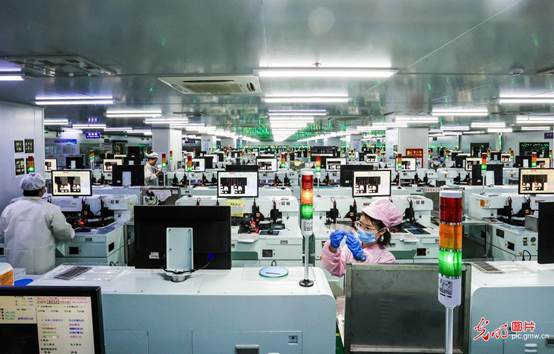
  

IMF managing director warns that trade fragmentation may lead to a new cold war in the world.

  Xinhua News Agency, Washington, April 14th (Reporter Pan Lijun, Yang Shilong) Georgieva, managing director of the International Monetary Fund (IMF), said on the 13th that the fragmentation of global trade will cost the world and may even trigger the second cold war. She called on all parties to make rational decisions and avoid a new cold war.

  On the same day, Georgieva said at a press conference of the IMF and the World Bank in the spring of 2023 that since the new crown epidemic and the Ukrainian crisis, the priority of ensuring the safety of supply chain and the reliable operation of global supply chain is reaching a new height in economic discussion and decision-making.

  Georgieva said that the discussion on how to involve developing countries in the supply chain and explore a more dynamic global division of labor is good. However, she also pointed out that the appeal of "friendly shore outsourcing" or supply chain reliability is not only economic, but also geopolitical.

  Georgieva called on all parties to make rational decisions and avoid pushing the world into the second cold war. She said that she had experienced the Cold War and knew that it would lead to brain drain, which was not conducive to world progress and did not want history to repeat itself.