Thermal power hot spring island
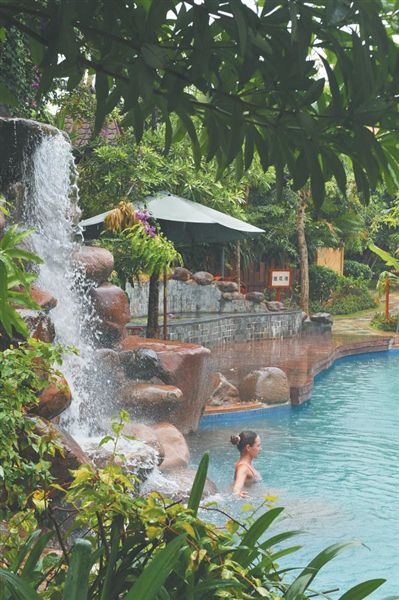
① Tourists "soak" in Nantian Hot Spring in Sanya.
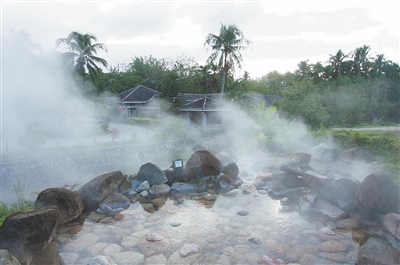
② Baoting Qixian Ridge Hot Spring.
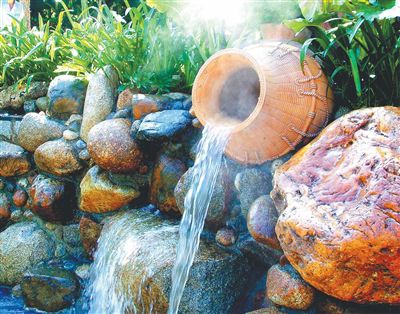
(3) Hot water gushed from hot springs in Qixian Ridge. source map
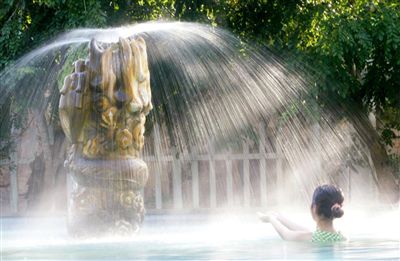
④ Hot water from Nantian Hot Springs. source map
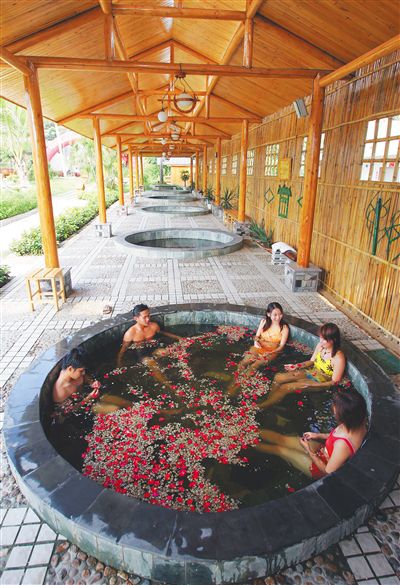
Tourists soak in hot springs in Qionghai Guantang.
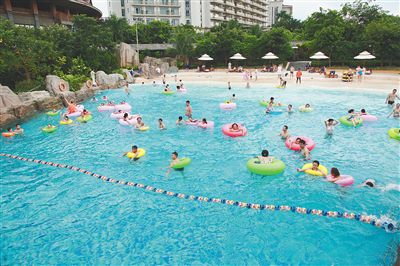
Citizen tourists play in the European area of Mission Hills Volcanic Rock Hot Springs in Haikou. source map

Hot spring meal at Lanyang Hot Spring in Danzhou.
Among many geothermal resources, hot spring is a kind of geothermal resource with magical integration and interaction of various space materials. According to China people’s view of heaven and earth, it is undoubtedly a creature of Zhong Ling.
Before the hot spring "debuts", it usually goes through two steps: sinking and rising. First, water molecules in the atmosphere penetrate into the pores of the earth’s rocks in the form of rain or snow melting, and gradually sink to the deep part of the earth and become circulating groundwater.
Then, the huge heat generated in the deep part of the earth heats the groundwater, causing the groundwater to rise along the crack channel when it encounters cracks or faults in the earth’s crust, and finally rush to the surface. When crossing the cracks in the rock stratum upwards, the groundwater absorbs minerals such as calcium, magnesium and sulfur, and finally "appears" in the form of hot spring water.
Hainan Island, located in the continental margin of the Pacific plate, separated from the South China continental plate and faced each other across the sea in the long and complicated geological structure evolution. The unique geotectonic background, stratigraphic sedimentation, tectonic movement and magmatic movement in different geological ages have created various types of minerals, geological relics, geothermal hot springs and geothermal fields on Hainan Island. Hainan Island is rich in hot spring resources and is a veritable hot spring island. Since ancient times, Hainan people have developed and utilized hot springs, forming a unique life experience and cultural memory.
A
39 geothermal hot spring resources have been discovered.
Geothermal resources can be divided into three types: shallow geothermal energy type, hydrothermal type (heat energy is carried by water) and dry (wet) thermal rock type. Hydrothermal geothermal resources are the dominant geothermal resources in Hainan, and hot springs are one kind of hydrothermal geothermal resources, which were developed and utilized earlier in Hainan, and the more mature way of development and utilization is to recuperate and bathe.
The Study on Geothermal Resources of Hainan Island written by Liu Changzhu, Wen Jian and Xue Guicheng of Hainan Geological Survey Institute mentioned that there are natural hot springs exposed on the land surface of Hainan Island except Haikou, Wuzhishan, Ding ‘an and Lingao. There are boreholes in Haikou and Lingao to expose medium and low temperature hot water. Generally speaking, there are many hot springs in Hainan Island, which are widely distributed. There are hot springs in Danzhou Lanyang, Qionghai Guantang-Wenchang Guanxin, Baisha Bangxi-Guangya, Dongfang Xinjie-Dimethyl, Changjiang Qicha, Sanya Nantian-Yacheng, Baoting Qixian Ridge, Lingshui Nanping-Yingzhou, Wanning Xinglong and other places.
As a geothermal resource, the temperature of hot spring water is higher than that of ordinary surface water. How many degrees Celsius is it? According to national standards, the annual water temperature of groundwater is greater than or equal to 25℃, which can be regarded as geothermal resources. Hainan Island is located in the tropics, with an average annual temperature of 24.1℃, and the groundwater temperature is high all the year round. If the groundwater with annual temperature greater than or equal to 25℃ is regarded as geothermal resources, the groundwater in Hainan Island basically belongs to geothermal resources. Therefore, Hainan takes 32℃ as the boundary temperature of geothermal resources.
Wang Xiaolin, a senior engineer of Hainan Geological Survey Institute, said that at present, 39 uplift mountain geothermal resources, also known as natural hot springs, have been discovered in Hainan Island. These natural hot springs are mainly distributed in Danzhou, Baisha, Dongfang and Ledong in the west of Hainan Island, Qionghai, Wanning and Lingshui in the east of Hainan Island, Baoting and Sanya in the south, and the water temperature is generally above 60℃, among which Baoting Qixian Ridge hot spring has the highest water temperature of 97℃.
Because the formation of geothermal resources is closely related to fault movement, magmatic movement, stratigraphic lithology and hydrogeological conditions, there are differences in hot spring water temperature in different regions. Specifically, the hot springs with higher temperature are mainly distributed in Wenchang, Wanning and Sanya in the southeast of Qiongdao, while the hot springs with lower temperature are mainly distributed in Baisha Basin and southwest of Qiongdao.
B
The development and utilization of hot springs can be traced back to the Ming Dynasty.
There is a small yard in Gaodi Village, Yazhou District, Sanya City. There are four rectangular or semi-circular hot pools made of stones in the yard. There are natural hot springs in the pools, which are inexhaustible for years, and the temperature is kept above 70℃ all the year round. These hot pools were built in Zhengde period of Ming Dynasty and have a history of more than 500 years. They are the earliest natural hot springs developed and utilized in Hainan.
In the 15th year of Guangxu reign in Qing Dynasty (1889), Tang Jingyuan, the magistrate of Yazhou, and Zhou people renovated these hot pools, and built ji ji Pavilion and Hot Water Temple 10 meters north of the hot pools, and engraved the inscription on ji ji Pavilion Hot Pool. These hot pools were originally called "ji ji Pavilion Hot Pool". Later, Ji Dawen, a local scholar in Yazhou, called these hot pools "Yujing Hot Springs" and listed them as one of the "new eight scenic spots in Yazhou" in Qing Dynasty, and wrote poems to express his ambition. In the 25th year of Guangxu in Qing Dynasty (1899), Zhong Yuandi, the magistrate of Yazhou, took office in Yazhou, and agreed with Ji Dawen’s theory of "New Eight Scenery of Yazhou", but changed the name of "Yujing Hot Spring" to "Hot Springs Wash Jade" and included it in the Annals of Yazhou in Guangxu.
Guantang Hot Spring, located at the foot of Baishiling Mountain in Qionghai, is also an early developed hot spring in Hainan, and its spring water is inexhaustible all the year round. It is said that there was a drought in Qionghai one year, and many wells in the vicinity dried up, even more than half of the riverbed of Wanquan River was exposed. Only Guantang Hot Springs surged as before, covered with water mist, and local residents used hot spring water to irrigate farmland. Due to folk rumors that the spring water of Guantang Hot Spring came from the East China Sea, officials often set up an altar here in the Qing Dynasty to hold rain and blessing activities. In the Records of Lehui County, which was revised in the third year of Xuantong in Qing Dynasty (1911), there was a record that officials begged for rain by Guantang Hot Spring: "The hot spring well is located in Sanjiling, Guiren, and the second point of Tangquan. In the twenty-first year of Jiaqing’s drought, the county owner Ji Guangbi took water for rain and stood up. " Perhaps it is because the government often holds activities next to hot springs, and over time, people call this hot spring Guantang Hot Spring.
The book Research on Geothermal Resources in Hainan Island mentioned that before the establishment of People’s Republic of China (PRC), the development and utilization of geothermal resources in Hainan was limited to bathing with natural hot spring water or using hot water to remove hair when slaughtering poultry and livestock. Until 1973, Hainan Geological Brigade (predecessor of Hainan Geological Survey Institute) conducted hydrogeological exploration on geothermal field in Xincun (now Qixian Ridge Hot Spring Area) of Baoting Li and Miao Autonomous County.
After the establishment of Hainan Province in 1988, the demand for geothermal resources in real estate, tourism and other industries increased. Hainan Geological Survey Institute successively explored and evaluated 11 geothermal fields, including Wanning Xinglong, Sanya Nantian, Qionghai Guantang, Danzhou Lanyang, Chengmai Xida and Baoting Qixian Ridge. Later, these places successively relied on natural hot springs and other resources to build hot spring leisure tourism resorts.
At the same time, some geothermal resources have been explored in the east bank of Nandujiang, Guoxing Avenue and yangshan area, creating conditions for tourist hotels and residential quarters to use geothermal water.
C
Deep development and promotion of Hainan’s "thermal value"
In Nantian Hot Spring Resort, Haitang District, Sanya City, more than a dozen hot spring pools of different sizes are scattered under green trees, and bubbling hot water gurgles out. Smelling the fragrance of vegetation, accompanied by sunrise and sunset, tourists soak in steaming "spring soup" for a while, and their fatigue is swept away.
China is one of the countries with the largest number of hot springs in the world, and it is also one of the earliest countries to develop and utilize hot springs. There is a record about hot springs in Shan Hai Jing written in the pre-Qin period: "If the water is warm as soup, it will get worse, so it is called hot springs." Who was the first to soak in hot springs? Although it is impossible to verify, if we look at the records of hot springs in ancient Chinese literature, we will find that since people began to use hot springs, it has been linked with health care and curing diseases.
Relevant investigations show that among the 39 uplift mountain geothermal resources in Hainan Island, except Zhongsha Hot Spring Point, no water quality data can be collected for evaluation. The contents of fluorine and metasilicic acid in other 38 geothermal fields all meet the standards of physiotherapy hot mineral water, which can be named as fluorine and silica hot mineral water, which has physiotherapy value. Most of the natural hot spring water in Hainan is rich in bromine, iodine, calcium and other elements beneficial to human body, which is high-quality hot mineral water.
Unfortunately, the exploration, development and utilization of geothermal resources in Hainan have not been able to form a replicable model. The use of geothermal fields such as Xinglong, Guantang, Lanyang and Qixian Ridge, which are mature, is limited to bathing and health care, and a platform for dynamic monitoring, supervision and management of hot mineral water has not been established. Due to the limited exploration technology and funds, other natural hot springs that have not yet been developed and utilized cannot be regularly monitored and developed and utilized on a large scale.
According to incomplete statistics, at present, only 10 of the 39 uplift mountain geothermal resources in Hainan Island have been developed and utilized in a preliminary scale, and the remaining 20 places have not been utilized or effectively utilized for various reasons.
Wang Xiaolin believes that geothermal energy is stored underground, which is not affected by climatic conditions and has great development potential. As a clean energy source, geothermal energy has been widely concerned all over the world. At present, the degree of development and utilization of geothermal resources in Hainan Island is generally low, and the form of development and utilization is single, and there is no management model of development and utilization of geothermal resources with Hainan regional characteristics. He suggested that we should further do a good job in the exploration, development and utilization planning of geothermal resources, actively explore cutting-edge technologies for exploration, development and utilization based on the kangyang industry, and enrich the application scenarios of geothermal resources, such as geothermal refrigeration and power generation. Making full use of abundant geothermal resources will help push Hainan’s green development to a new level. (Hainan Daily, all-media reporter Sun Hui)
Guide to "Soaking Springs" in Qiongdao
Generally speaking, people are more accustomed to soaking in hot springs in winter to drive away the cold. However, some medical and health professionals believe that soaking in hot springs in summer can achieve better results according to the theory of "treating winter diseases in summer" and "nourishing yang in spring and summer" in traditional Chinese medicine, and put forward the method of recuperation in hot springs. Hainan Island is rich in hot spring resources, and there are many underground hot mineral waters that have been artificially developed and utilized. It is a good choice to come to Hainan to soak in hot springs in summer!
Qionghai Guantang Hot Spring
Located in Jiaji Town, qionghai city, it was developed and utilized as early as 1995. Guantang Hot Spring is rich in hydrogen sulfide beneficial to human body, and the facilities such as soaking pool are relatively complete.
Wanning Xinglong Hot Spring
Before the 1940s, local residents in Xinglong had used hot springs for bathing. In 1994, Xinglong began to use hot springs to develop tourism. The local hot springs are rich in silicon dioxide and fluorine, also known as "fluorosilicone water".
Lingshui Nanping hot spring
Located in Qunying Township, Lingshui Li Autonomous County, it is different from the hot spring seeping between rocks. The hot spring is exposed in the river bed, and spring water will seep as long as a hole is dug by the river. The temperature of spring water can reach 77℃, and the fluorine content is high.
Baoting Qixian Ridge Hot Spring
Qixian Ridge is a famous hot spring tourist attraction in Hainan. The water temperature of Qixian Ridge hot spring is 70℃ to 97℃, which is a relatively rare alpine artesian hot spring. In the hot spring pool surrounded by mountains, it is very beautiful to listen to insects singing and birds singing and watch clouds steaming.
Nantian Hot Spring in Sanya
Located in Haitang District, Sanya City, it has built a hot spring resort as early as 1990s. Nantian Hot Spring has a height of 7.8 meters and a water temperature of about 57℃. The spring water is rich in silicic acid, fluorine, radon and other elements, and it is fluorine-silicon low-temperature hot mineral water.
Tung fong hung hing hot spring
There is a hot spring near Gaopoling Reservoir in Dongfang City, which was called Wentang Spring in ancient times, but now it is called Hongxing Hot Spring. Because it is full of smog all day, it is commonly known as "Yantang", and the water temperature is as high as 80℃. The spring water is rich in fluorine and silicon.
Baisha Fuxi Hot Spring
Fuxi Hot Spring (also known as Guangya Hot Spring) is located in a mountain forest in Qifang Town, Baisha Li Autonomous County. Hot spring water gathers in one place to form a crystal-clear pool with a water temperature of about 40℃.
Danzhou Lanyang Hot Spring
Located in Lanyang Town, Danzhou City, it has been identified as a hot radon spring with the largest radon content in the world, and the radon content in the spring water is as high as 660 Bq/L. The hot spring water temperature can be as high as 97.3℃, and vegetables and meat can be cooked. Visitors can taste hot spring hot pot here.
Chengmai Jiulegong Hot Spring
Located in Jiuleshan, Chengmai County, the water temperature is about 57.1℃. Legend has it that the dragon once went to Jiuleshan to bathe, and local residents called the spring water of Jiulegong Hot Spring "clean body and dragon water".
Haikou Guanlan Lake Volcano Hot Spring
There is mineral water under the volcanic lava distributed in Qiongbei area. Related enterprises take underground mineral water to build hot spring pools, and use the names of five continents to plan and build five kinds of hot spring areas.
The pictures were taken by Wang Kai, an all-media reporter of Hainan Daily, except for the signature.